

Wasting your time on "free" consultations is a massive revenue leak for a small firm. Giving away 30-minute blocks of your expertise fills your calendar with unqualified leads and signals that your advice isn't valuable enough to pay for.
Charging for consultations is the single best filter you have. It weeds out tire-kickers, attracts serious clients ready to invest in a solution, and immediately boosts your bottom line. This guide will show you how to confidently set your attorney consultation fee and turn those initial meetings into paying clients.
Why Your Firm Must Charge for Consultations
The free consultation model is a relic that costs small firms dearly. Every hour you spend giving away legal advice is an hour you can't bill an actual client. You need to treat your time as a billable asset, and that starts with understanding how much an attorney consultation fee can add to your revenue.
When you charge a fee, you establish immediate authority and communicate the value of your counsel. In fact, 67% of clients choose the first firm that responds professionally, and nothing says "professional" like valuing your own time. A paid consultation is the first step in a professional engagement, setting the stage for a much smoother transition from prospect to signed client. To optimize this first impression, check out our complete guide to law firm client intake.
Let's look at the numbers. Lawyer consultation fees in the U.S. typically range from $150 to $750, with many firms landing around $300 to $400. If your firm conducts just three paid consultations a week at $300 each, you'll add over $46,000 in annual revenue. That's money you were previously leaving on the table.
The True Cost of "Free"
Think about the administrative drag of "free" meetings. You have the back-and-forth scheduling, prep time, the meeting itself, and the follow-up. When a prospect has no skin in the game, your no-show rate skyrockets, leaving dead gaps in your day.
This is exactly why so many firms are moving away from free advice. Tools like time tracking software for lawyers can be eye-opening, showing you just how much "free" is costing you in lost billable hours.
A paid consultation solves this by requiring a commitment upfront. It ensures that when someone books your time, they are serious about moving forward. To structure that next step, learn more about how retainers work for lawyers.
Setting Your Fee: What to Charge by Practice Area
There’s no magic number for an attorney consultation fee. Your rate depends on your practice area, location, and the tangible value you deliver in that first meeting.
Some practice areas, like personal injury or workers' compensation, are built on free consultations because the cases are taken on contingency. The consultation is purely a lead qualification tool.
But if you’re in family law, business law, or estate planning, your advice is the product. A client walks away with a strategic roadmap or professional feedback on a critical document. In these cases, you absolutely must charge for your expertise.
Typical Attorney Consultation Fees by Practice Area
So, how much is an attorney consultation fee that makes sense for your firm? It often aligns with typical hourly rates, which can span from $200 to over $1,000 per hour. For example, divorce lawyers often average $250-$450 per hour, while a flat fee to review a business contract might fall between $500-$2,500. You can always dig into more detailed pricing dynamics from industry reports to get a sharper picture.
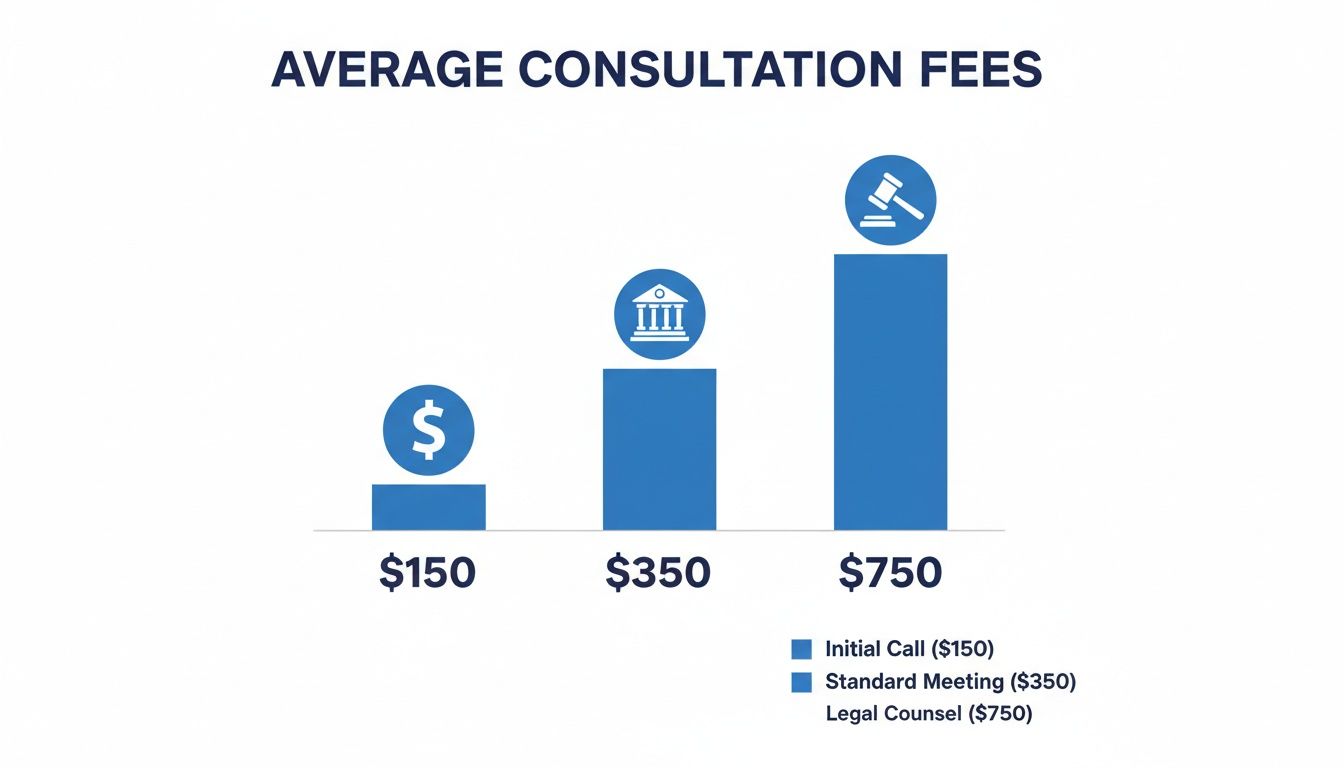
Here's a quick reference table showing common fee structures across different types of law to guide your decision.
| Practice Area | Common Fee Model | Typical Fee Range |
|---|---|---|
| Personal Injury | Free (Contingency) | $0 |
| Family Law | Flat Fee or Hourly | $150 - $500 |
| Estate Planning | Flat Fee | $250 - $750 |
| Business Law | Hourly or Flat Fee | $300 - $1,000+ |
| Criminal Defense | Flat Fee | $100 - $500 |
| Immigration | Flat Fee | $150 - $400 |
| Bankruptcy | Free or Flat Fee | $0 - $300 |
Use these ranges as a guide, but always factor in your own experience and local market conditions.
The Best Pricing Structures for Consultations
Your fee structure needs to be simple and instantly understandable. Avoid complex calculations that create confusion.
Here are the most effective models for small law firms:
- Flat Fee: This is the best model for most consultations. Charge a single, fixed price (e.g., $350) for a set amount of time (e.g., one hour). It's predictable and removes the fear of a running clock.
- Hourly Rate: Reserve this for consultations you know will run long or involve complex document review. Always be clear about your rate and provide a time estimate upfront.
- Credit Towards Retainer: This is your most powerful conversion tool. Charge your standard fee but agree to apply it as a credit toward the client's retainer if they hire your firm within a specific window (e.g., 48 hours).
The "credit toward retainer" model creates urgency and makes the client feel their initial investment is already working for them, giving them a compelling reason to sign faster.
How Location and Experience Impact Your Consultation Fee
Your firm’s address and your attorneys' expertise are the two biggest factors that dictate your pricing power. You have to price for your market, not some imaginary national average.
Firms in major cities have higher overhead, but it's more than that. Clients in markets like New York or San Francisco expect to pay premium prices for specialized help, and your fee must reflect that reality.
Geographic Pricing Differences for Lawyers
The difference in what you can charge based on geography is stark. It’s not uncommon for firms in major U.S. cities to charge nearly double what their rural counterparts do. A fee in the $300-$750 range is perfectly normal for an initial meeting in a hub like New York. You can dig into some of these geographic pricing trends on BestLawyers.com.
This means you can't just copy a pricing model from a firm one state over. Know the going rates in your city for your practice area. A quick way to find this is to discreetly check the websites of a few respected local competitors.
Justifying a Higher Fee with Your Expertise
Beyond your zip code, your firm's experience is your most powerful pricing tool. A seasoned attorney with a proven track record, special credentials, or a rock-solid reputation can and should charge more.
Your fee is a reflection of your value. Clients aren't paying for an hour of your time; they are paying for your judgment, which is built on years of solving tough problems.
Here are concrete ways to justify a premium rate:
- Highlight Specific Credentials: Board certifications, advanced degrees, or legal organization awards are all reasons to charge more. Make sure they are front and center in your marketing.
- Showcase Your Track Record: Use case studies or testimonials (ethically, of course) to demonstrate your firm's success with similar cases.
- Emphasize Niche Specialization: If you only handle a very specific type of law, that specialization implies a deeper level of expertise that justifies a higher fee.
How to Justify Your Fee and Handle Objections
Charging for your time is easy. Getting a potential client to feel good about paying for it is a skill that directly impacts your conversion rate.
Frame the fee not as a barrier, but as their first investment in an expert legal strategy. Shift the conversation from cost to value. Be crystal clear that the fee buys them an in-depth case review, identification of key legal issues, and an actionable roadmap—value only a lawyer can provide.
Communicating Value Proactively
Your website, intake forms, and emails must hammer home the value of a paid consultation. Don't just list a price; explain what they get for their money.
- Strategic Case Review: Promise an in-depth analysis of the facts they provide, not a surface-level chat.
- Identification of Key Issues: Explain that your trained eye will spot critical legal challenges and opportunities they can't see.
- Actionable Next Steps: Promise a plain-English plan they can use, whether they hire you or not.
This proactive approach disarms price objections before they form. By the time a prospect sees the fee, they already understand its tangible benefits.
Scripts for Handling Price Objections
Even with the best setup, some people will push back. Don't get defensive. This is your chance to reinforce your value.
When a client objects to the price, try this script: "I understand. Let me quickly walk you through what this initial strategy session includes, so you can see why it's the most valuable first step you can take."
This validates their concern while smoothly pivoting the conversation back to the return on their investment. If they still refuse to pay, they've just told you they don't value your expertise—and saved you an hour of your time.
Creating a Seamless Consultation Payment and Intake Experience
How you collect your attorney consultation fee says a lot about your firm. A clunky process full of phone tag and manual invoices creates friction, and friction is where qualified leads get frustrated and move on to the next firm on Google.
Your goal is to make saying "yes" as easy as possible. A smooth, professional intake process is your best first impression, telling potential clients your firm is modern, efficient, and respects their time. It's how you get them committed before they can second-guess their choice. This is key to an effective intake process, as attorneys spend 48% of their time on non-billable administrative tasks that systems can solve.
The One-Link Solution to Convert Leads Faster
Imagine sending a single link to a new lead. In one click, they can pick a time, securely pay the consultation fee, and fill out your intake form. No phone tag. No chasing payments. This is the new standard.
This unified approach consolidates the entire booking and payment workflow. Here’s why it works:
- Eliminates Drop-Off: Every extra step is a chance for a lead to get distracted and fall out of your funnel.
- Guarantees Payment Upfront: Requiring payment at booking ends no-shows and ensures you only spend time with serious prospects.
- Automates Data Entry: The information they provide automatically populates their client file, cutting down on manual work.

This kind of integrated experience doesn't just impress clients. It fundamentally streamlines your firm’s operations, freeing up your team for billable work.
Connecting Your Tools for Efficiency
This isn't about one magical tool; it's about connecting the right tools into a single system. Modern legal practice management software for law firms can act as the central hub.
When you integrate your payment processor (like Stripe), your calendar, and your intake forms, you build a powerful machine that works for you 24/7. This system can automatically send reminders, process payments, and ensure you have all necessary client information before the consultation. For a deeper dive, check out our insights on how to improve your client onboarding process.
See how intake.link consolidates your entire intake process.
How to Turn Paid Consultations into Retained Clients
The point of a consultation fee isn't just to make a few hundred dollars. It's to turn a qualified prospect into a signed, paying client. That final step—from "great meeting" to "welcome aboard"—is a race against the clock.
Every hour that passes after a consultation gives a serious prospect time to cool off or call another firm. Your job is to close that gap. The key is to capitalize on the momentum you've built when the value of your advice is fresh in their mind. Don't end the call with, "I'll send over the paperwork." End it with an immediate path to becoming your client.

Apply the Fee as a Retainer Credit
One of the most effective conversion tools is to apply the consultation fee directly toward the client's retainer. This reframes the initial fee from a sunk cost into their first official investment in your firm.
This creates a powerful sense of urgency. A client who sees their $350 consultation fee immediately credited toward their retainer is far more likely to commit on the spot. It rewards them for taking decisive action.
Get Signatures and Payment on the Spot
The old way—emailing a PDF and waiting for a check—is a client-killer. To lock in clients, you need a single, unified system for collecting e-signatures and payments.
At the end of your consultation, your process should be this simple:
- Present the Agreement: Once they verbally agree, immediately send them one link.
- Guide Them to Sign: Stay on the call while they open the link and electronically sign your lawyer retainer letter.
- Collect the Retainer: The exact same workflow should then prompt them for their initial retainer payment via credit card.
This one-link process eliminates the dangerous waiting period where good leads go cold. You get a signed agreement and paid retainer before you even hang up the phone.
Frequently Asked Questions About Attorney Consultation Fees
Should I Apply the Consultation Fee to the Client's Retainer?
Absolutely. Crediting the consultation fee toward the client's retainer is one of the most effective closing techniques you can use. It makes the client feel their initial investment is already working for them, creating a powerful incentive to sign immediately and speeding up your conversion from prospect to paying client.
What Is the Best Way to Collect the Fee Online?
Use an integrated online system that handles scheduling, payment, and intake in one seamless flow. A modern tool that connects to a payment processor like Stripe is the gold standard. The client books a slot, pays the fee securely, and fills out their information in the same process, eliminating awkward money conversations and guaranteeing payment upfront.
How Do I Handle Prospects Who Refuse to Pay?
Hold your ground, politely but firmly. Explain that the fee covers the professional legal advice and dedicated time you provide during the session, which has real value. A refusal to pay is a major red flag—it signals the person either doesn't value your expertise or isn't a serious client. The fee is a filter, and it just did its job.
Stop losing leads while you wait for signatures. intake.link combines your entire intake process into a single, seamless flow, so you can get retainers signed before prospects have time to call another firm.
Stop losing leads—get signatures before they call another firm