

If you're tired of unpredictable referrals and want a direct line to clients who are ready to hire, SEO for lawyers is your answer. It's not about playing tech games; it’s about making your firm the first one a potential client finds and calls when they search on Google for the exact problem you solve.
When someone searches "car accident lawyer near me" or "how to file for divorce in Texas," a smart SEO strategy ensures your firm is the one they find. This guide gets straight to the practical steps you can take to make that happen.
Why SEO Isn't Optional for Your Small Firm
Relying solely on referrals is like having a billboard in the desert. Your best clients are on their phones, typing urgent legal questions into Google. Showing up on that first page of results is the difference between a steady stream of high-value cases and being invisible to the people who need you most.
And the data doesn't lie: a staggering 64% of people turn straight to Google when they need legal help. If your firm isn't there, you're not just missing leads—you're handing them to your competitors.
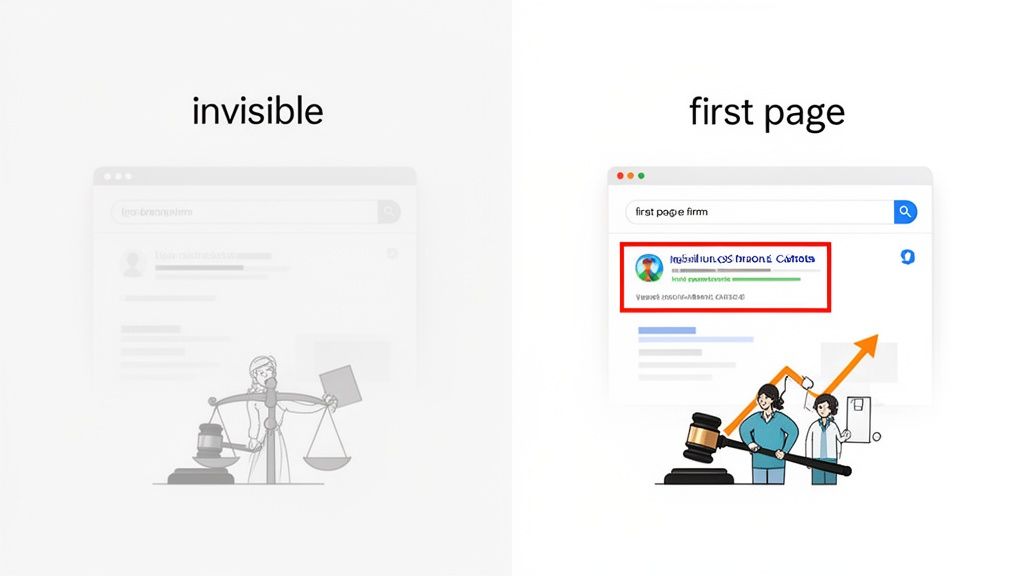
Dominate Your Local Market with SEO
For small firms, effective SEO for lawyers is a battle for local supremacy. When someone faces a legal crisis, their search is almost always local. Your competition knows this—an overwhelming 94% of law firms report that search engines are their most important channel for building brand awareness.
If you want to dive deeper, you can learn more about these legal marketing statistics and what they mean for your bottom line. The takeaway is simple: if your firm isn't visible on that first page, your competition is taking your clients.
Attract Higher-Value Cases, Not Just More Calls
A powerful SEO presence does more than just make the phone ring; it makes the right kind of client call. By targeting keywords related to your most profitable practice areas, you connect with people at the precise moment their need is greatest.
This flips the script on client acquisition. Instead of taking whatever comes through the door, you build a predictable pipeline of cases that align with your firm’s goals.
SEO isn’t a marketing expense; it’s a client acquisition system. It builds a sustainable pipeline of qualified leads that grows over time, creating a powerful asset for your firm.
The Real-World Impact of Lawyer SEO
Here's a quick look at what a dedicated SEO strategy can do for your firm. These aren't vanity metrics; they represent a fundamental shift in how your firm grows.
| Metric | Average Result | What This Means for You |
|---|---|---|
| Lead Volume Growth | 200% - 300% within 12 months | More qualified inquiries without increasing your ad spend. |
| Cost Per Lead | 60% lower than paid ads | A more cost-effective way to generate cases over the long term. |
| Conversion Rate | 14.6% (organic) vs 1.7% (print) | SEO leads are actively looking for a solution, making them far more likely to hire you. |
| Local Search Rank | Top 3 in Google Maps | Dominates the most valuable real estate for "near me" searches, driving calls and visits. |
When you pair this online visibility with a seamless client onboarding process, you create an unstoppable engine for turning traffic into retained clients. The key is to capture that lead the moment they find you, because leads contacted within 5 minutes are 21x more likely to convert. Learn more in our cornerstone guide on how to stop losing leads with faster conversions.
Understanding the Three Pillars of Law Firm SEO
SEO can feel complicated, but for a busy law firm owner, everything you need to know about SEO for lawyers boils down to three core areas. Get these right, and you'll go from invisible to being the first firm potential clients find.
Think of it like building a case: you need a solid foundation (technical), compelling evidence (on-page), and a strong reputation (off-page).
Pillar 1: Technical SEO — The Foundation
Technical SEO is the behind-the-scenes work that helps Google find, understand, and trust your site. If Google can’t properly read your site, even the most brilliant legal content won’t rank. You don’t need to become a developer, but you do need the basics locked down.
Critical elements include:
- Site Speed: A site that takes more than three seconds to load loses nearly half its visitors. They’ll just click back and go to your competitor.
- Mobile-Friendliness: Most of your potential clients are searching on their phones. Your website must work flawlessly on a mobile device—no excuses.
- Clean Structure: A logical site map helps users and search engines find what matters, like your practice area pages and contact info.
- Security (HTTPS): A secure site protects visitors and is a non-negotiable trust signal for Google. It's the digital equivalent of locking your office doors.
Pillar 2: On-Page SEO — Your Content and Structure
Once your site's foundation is solid, you focus on what’s on the pages. This is where you prove your expertise and target what your ideal clients are searching for. This is your digital sales pitch, demonstrating your authority on topics like "what to do after a car accident in Houston."
It also involves optimizing the small but mighty details, like your page titles and meta descriptions—the headlines and summaries people see in search results that convince them to click your link.
On-page SEO is all about speaking your client's language. It aligns your firm’s expertise with the exact phrases people use when they need a lawyer, making you the most relevant answer to their search.
Pillar 3: Off-Page SEO — Your Digital Reputation
The final pillar is about building your firm’s authority across the rest of the internet. Think of it as your digital word-of-mouth. It’s what other websites and people are saying about you.
For lawyers, this comes down to two key components:
- Backlinks: These are links from other reputable websites pointing to yours. A link from the local bar association or a news article quoting you acts as a vote of confidence, telling Google your firm is a credible authority.
- Client Reviews: Positive reviews on your Google Business Profile and directories like Avvo are unbelievably powerful. They influence potential clients and directly impact your rankings in local search results.
These three pillars—technical, on-page, and off-page—work together. A technically sound website allows your great content to be found, and a strong digital reputation proves to Google that your content is worth ranking at the top.
Winning Locally: Optimize Your Google Business Profile
For your law firm, the best clients are right in your backyard. Winning at SEO for lawyers starts with dominating local search, and your most powerful tool is your Google Business Profile (GBP). It's often the very first impression a potential client has of your firm.
When someone searches "divorce lawyer near me," Google shows the "Local Pack"—that map with three law firm listings. Getting your firm into that box is non-negotiable for a steady stream of local leads.

Fully Optimize Your Profile Information
A half-finished profile signals to Google and potential clients that you don’t pay attention to detail. To show up, you need to master Google local listings by filling out every single field accurately.
Consistency is everything. Your firm's Name, Address, and Phone number (NAP) must be identical across your website, GBP, and any other directory. Even a tiny difference like "St." vs. "Street" can confuse Google and hurt your ranking.
Use GBP Features to Build Trust and Authority
Your GBP isn't just a static listing; it's an active platform. Consistent activity sends strong positive signals to Google.
- Photos: Regularly upload high-quality photos of your office, your team, and professional headshots. It humanizes your firm and proves you're an established practice.
- Google Posts: Use this feature like a mini-blog to share firm news, recent results (ethically), or quick summaries of your articles. It keeps your profile fresh.
- Q&A Section: Proactively ask and answer common questions like, "Do you offer free consultations?" This positions you as a helpful authority.
The Power of Client Reviews for Law Firm SEO
Reviews are the lifeblood of local SEO. They provide social proof and are one of the most significant factors in Google's local ranking algorithm. A steady stream of recent, positive feedback convinces a hesitant searcher to call you.
Google isn't just glancing at your star rating. It's analyzing the quantity, velocity, and recency of your reviews. A firm with 50 recent four- and five-star reviews will almost always outrank a firm with 20 perfect but stale reviews from three years ago.
Make asking for a review a standard part of your case-closing workflow. The easier you make it for a happy client, the more likely they are to do it.
A well-managed GBP shortens the distance between a client's search and their call to your firm. When you pair that visibility with a fast intake process, you create an unbeatable system for growth. Learn more about the importance of law firm lead response time.
Creating Content That Attracts Your Ideal Clients
Technical fixes and a solid Google profile get you on the field, but killer content is how you win. Great content answers the urgent, specific questions your ideal clients are typing into Google. The core of effective **SEO for lawyers** is turning your website into a magnet for the exact cases you want.Forget generic legal articles written for other lawyers. Your mission is to speak directly to a potential client's immediate, stressful problem. You're not just trying to get traffic; you're trying to attract the right traffic.
Start with Keyword Research for Legal Intent
Keyword research is simply finding the exact phrases potential clients use when they need a lawyer. It’s the blueprint for your entire content strategy. Instead of guessing, you use real data to guide your efforts.
Put yourself in their shoes. They aren't searching for "tort law." They're searching for things like "what to do after a slip and fall at a grocery store." These longer phrases, called long-tail keywords, are goldmines because they signal high intent—the person is likely looking to hire someone now. Tools like Ahrefs or SEMrush are great, but even a simple Google search will reveal the "People also ask" questions you need to be answering.
Build Your Content Pillars: Practice Area Pages and Blogs
A high-performing law firm website needs two types of content working together: practice area pages and blog posts.
- Practice Area Pages: Think of these as your digital sales pitches. A page for "DUI Defense" must be focused on conversion. It needs to outline your services, answer pressing questions, showcase your authority, and make it easy to get in touch.
- Blog Posts: These are your trust-builders. Your blog is where you answer questions people have before they're ready to call, like "How is Child Support Calculated in California?" This establishes you as the expert, so you're the first call they make when they are ready.
Your practice area pages convince clients to hire you now. Your blog content proves you're the expert they should have hired yesterday. Both are essential.
This two-pronged approach ensures you capture clients at every stage. In fact, 65% of firms now consider their website their top source for new business. You can read more about legal marketing trends on attorneyatwork.com to see where the industry is headed. All the traffic in the world is useless if you can't turn that interest into a signed retainer.
Adapting Your Law Firm's SEO for AI Search
The world of legal search is changing fast, but for a nimble law firm, this is a massive opportunity. You don't need to become an AI expert; you just need to grasp how your potential clients are now finding answers and tweak your SEO for lawyers playbook.
At the center of this shift are Google's "AI Overviews"—summarized answers at the top of many search results. Instead of sifting through links, potential clients get direct, AI-compiled answers. This is a fundamental change in how people find a lawyer.
From SEO to GEO: The New Playbook for Lawyers
This new reality calls for a pivot from traditional Search Engine Optimization (SEO) to what many call Generative Engine Optimization (GEO). The goal is no longer just to rank #1. The new goal is to have your firm’s expertise featured directly inside these AI-generated summaries.

AI is designed to find the most trustworthy and helpful information. That means all the foundational work of building a strong reputation and creating high-quality content is now more critical than ever.
Building Trust Signals for AI and Humans
So, how do you convince an AI that your firm is the go-to source? You double down on proving your credibility. AI, like a discerning client, is looking for strong signals of Experience, Expertise, Authoritativeness, and Trustworthiness (E-E-A-T).
Strengthen your online reputation by focusing on these key areas:
- Beef Up Your Attorney Bios: Detail your specific case experience, publications, speaking engagements, and bar association memberships. This is concrete proof of real-world expertise.
- Create Clear, Factual Content: Write articles that give direct answers to common legal questions. Use simple headings and bullet points to structure information so it’s easy for AI to parse and feature.
- Get Third-Party Validation: Go after reviews on your Google Business Profile and mentions from reputable places like local news outlets or legal associations. Think of these as powerful, independent votes of confidence.
Your online reputation is no longer just for potential clients. It’s for search engine AI to analyze. Every review, citation, and byline contributes to a digital "credibility score" that helps determine if you get featured.
Ultimately, the rise of AI in search is a huge win for firms that are genuinely authoritative. For a deeper dive, there are fantastic resources on optimizing content for AI search that offer actionable strategies.
Turning Your SEO Traffic into Signed Clients
Getting a potential client to your website is only half the battle. If your intake process is slow or confusing, you’re losing those hard-won SEO leads to the first law firm that responds. All your effort is wasted if you can’t efficiently turn traffic into signed, paying clients.
This is where your SEO for lawyers strategy connects directly to your bottom line. It's not just about getting clicks; it's about turning those clicks into retainers before your competitors can.
Speed Is Your Greatest Competitive Advantage
In the legal field, the first firm to respond professionally often wins the client. Phone tag and back-and-forth emails give your leads golden opportunities to call another attorney.
A lead contacted within just 5 minutes is 21x more likely to convert. Waiting even an hour can cause that probability to plummet as their sense of urgency drives them to find someone who can help them now.
Your intake process must be built for speed and simplicity. You need a system that captures a lead's commitment immediately, before they have a chance to continue their search.
Eliminating Friction from Your Intake Workflow
Every extra step in your intake process is a potential exit point for a client. Asking them to download, print, sign, scan, and email a PDF is a recipe for abandonment. Juggling separate tools for forms, signatures, and payments creates a disjointed experience that screams inefficiency.
The goal is to make saying "yes" to your firm the easiest decision they make all day. This table shows the stark difference between a leaky intake funnel and a modern, high-conversion workflow.
Old Intake vs. Modern Intake Workflow
| Step | Traditional Process (High Drop-Off) | intake.link Process (High Conversion) |
|---|---|---|
| 1 | Client finds site, fills out basic form. | Client finds site, clicks one link. |
| 2 | Staff emails a separate retainer agreement. | Client completes the full intake form. |
| 3 | Client prints, signs, and scans the document. | Client e-signs the retainer agreement. |
| 4 | Staff sends a separate payment link or invoice. | Client pays the retainer fee instantly. |
| 5 | Client must find a way to pay (check, wire). | The entire onboarding process is complete. |
| 6 | Staff manually enters all data into systems. | All data flows into your systems automatically. |
The modern approach consolidates these steps into a single, seamless experience. A client finds you on Google, clicks "Get Started," and in one flow completes their intake, signs your retainer, and pays their deposit. By the time another firm calls them back, they are already your client.
For a closer look at how modern tools achieve this, check out our deep dive into client intake software for law firms.
From Clicks to Conversions: Your Next Steps
Maximizing the ROI from your SEO investment requires a bridge between your online visibility and your operational efficiency. You worked hard to get noticed on Google; now, be ready to capture that attention instantly.
Audit your current intake process from the perspective of a stressed, impatient client. How many steps does it take? How long would you wait?
Stop losing leads—get signatures before they call another firm.
Real Talk on SEO for Small Law Firms
If you're running a busy practice, you have straightforward questions about what it really takes to get clients from Google. Let's skip the jargon and get right to your concerns about cost, time, and what's actually possible.
How Much Does Law Firm SEO Cost?
The honest answer is: it depends. SEO services can range from $2,000 to over $10,000 a month. The price is tied to how competitive your market and practice area are. A family law attorney in a small town is playing a different game than a personal injury firm in downtown Los Angeles.
The right mindset is to stop seeing SEO as a marketing expense. It’s an investment in an asset. Unlike a PPC ad that vanishes the second you stop paying, good SEO builds a client-generating machine that pays dividends for years.
How Long Does SEO Take to Show Real Results?
SEO is a marathon, not a sprint. While you might see encouraging signs in local rankings within 3 to 4 months, getting a steady, predictable flow of cases takes patience.
For most law firms, plan on seeing game-changing results—the kind that meaningfully impact your bottom line—within 6 to 12 months of consistent, focused effort. SEO builds momentum that creates a powerful, sustainable source of high-quality leads.
This long-term strategy builds real authority and a stable presence that doesn't crumble with every minor algorithm update. It's about laying a foundation for predictable growth.
Can I Do My Own Law Firm SEO?
Absolutely. You can tackle the foundational pieces yourself. Managing your Google Business Profile, encouraging client reviews, and writing blog posts on topics you know inside and out are fantastic places to start.
However, the more technical side—site audits, schema markup, and strategic link building—usually requires a specialist. Many small firms find a hybrid approach works best: you handle the content and client-facing tasks while partnering with an expert for the complex technical work. This frees you up to do what you do best: practice law.
At intake.link, we believe your hard-earned SEO traffic should turn into signed clients, not more phone tag. Our platform connects your marketing directly to your revenue.
Stop losing leads. Start getting signatures before they have a chance to call another firm. See how intake.link consolidates your entire intake process.