

A slow or confusing lawer retainer letter process is more than an admin chore—it's a deal-killer. Every email attachment, print-and-scan request, and follow-up call for payment is an opportunity for a ready-to-hire client to lose momentum and call another firm. This guide shows you how to turn that bottleneck into your fastest path to a paying client.
Why Your Manual Retainer Process Is Costing You Clients
Let's get straight to the point: you are losing clients in the gap between "yes" and getting paid. The time it takes to get a signed retainer is the most dangerous part of your intake. Data shows leads contacted within 5 minutes are 21x more likely to convert. A clunky, multi-day documentation process sabotages that speed.
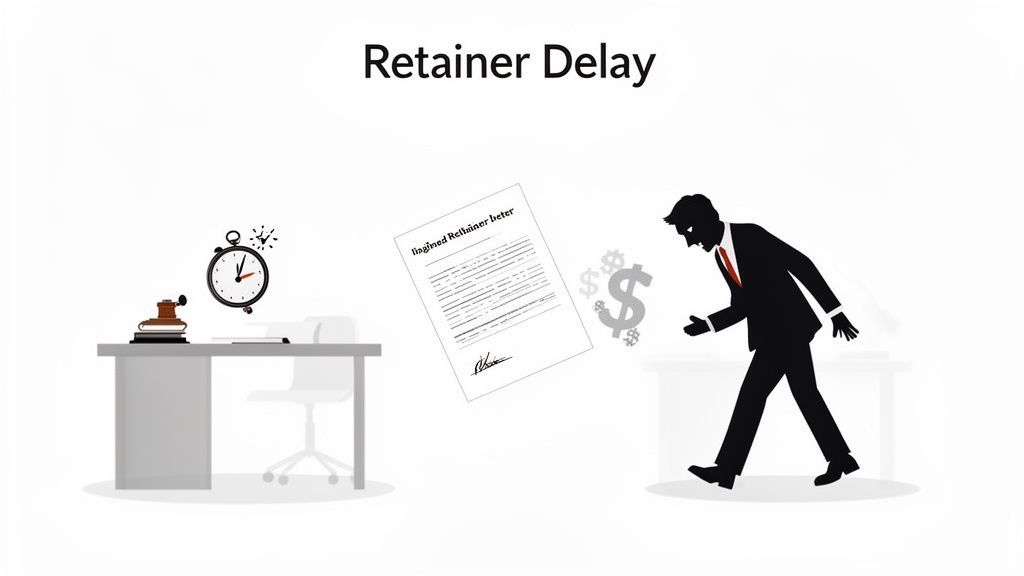
The old way of doing things doesn't work for today's clients. Your firm needs a system that moves at the speed of a text message, not a scanner. This is where you can stop losing leads and see your conversion rates climb. We'll show you how to leverage a modern process in this guide to stop losing leads and achieve faster conversions.
The Modern Advantage: How Digital Retainers Boost Conversions
Retainer agreements are a core offering for 60–67% of law firms for a good reason. Firms using e-signatures see 20% higher revenue and a 12% better conversion rate. Going digital isn't just about convenience; it makes your firm more profitable. You can read more about these legal industry trends and see the impact for yourself.
Your intake process is your first impression. A clunky, multi-step retainer signing experience signals your firm is slow. A one-link signature and payment process proves you value your client's time.
Before you can streamline the process, you need to be precise about the documents you use. These three terms are often used interchangeably, but they serve very different functions.
Retainer Letter vs Engagement Letter vs Retainer Agreement
Confusing these terms leads to mismatched expectations and client disputes. Let’s quickly clarify so you use the right document every time.
Here's a quick breakdown of the three documents that formalize a client relationship, highlighting their purpose and when to use each.
| Document Type | Primary Purpose | Key Focus | When to Use |
|---|---|---|---|
| Retainer Letter | To confirm the financial arrangement of the retainer fee. | Details the retainer payment, how it's held (trust account), and replenishment terms. | When the primary goal is to formalize the advanced fee payment for securing your services. |
| Engagement Letter | To define the scope and terms of the attorney-client relationship. | Outlines services, responsibilities, communication protocols, and fees (which may include a retainer). | At the start of any new client relationship to set clear expectations for the entire project. |
| Retainer Agreement | A comprehensive contract combining both financial and service terms. | Merges the scope of work from an engagement letter with the specific payment details of a retainer letter. | For most new matters, as it provides a single, legally binding document covering all aspects of the relationship. |
While a simple retainer letter works for a returning client on a new matter, a full Retainer Agreement is best practice for new clients. It eliminates ambiguity and covers all your bases in one document.
Anatomy of an Ironclad Lawyer Retainer Letter
Your lawyer retainer letter is the blueprint for the client relationship. It's your best tool for setting clear expectations and your primary defense against future disputes. Leaving out key details is a recipe for payment issues, scope creep, and unhappy clients.
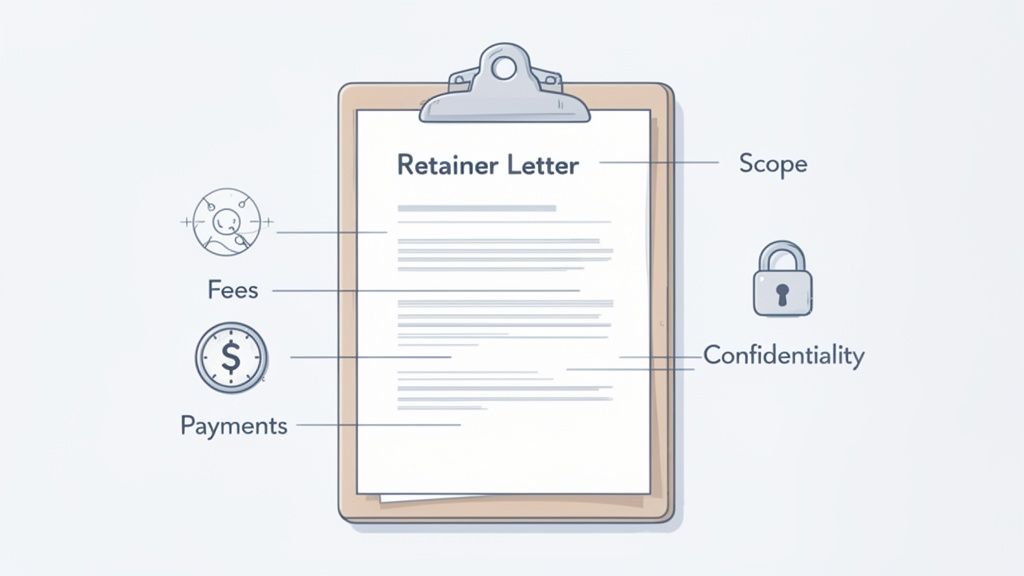
A vague letter creates ambiguity that almost always works against your firm. To protect yourself and build a healthy foundation, every letter must include these non-negotiable elements.
10 Must-Have Clauses in Your Retainer Letter Template
Think of this table as your pre-flight checklist before sending any retainer agreement.
| Clause | Purpose | Example Key Phrase |
|---|---|---|
| 1. Identification of Parties | Clearly names the client and the firm. | "This agreement is between Jane Doe ("Client") and Smith & Jones Law, PLLC ("Firm")." |
| 2. Scope of Services | Defines exactly what you will and will not do. | "This representation is limited to... and expressly excludes..." |
| 3. Fee Structure | Details how you will be paid (hourly, flat, contingency). | "The fee for these services will be billed hourly at a rate of $450/hour for partners..." |
| 4. Retainer Deposit | Specifies the upfront payment amount. | "A refundable retainer of $5,000 is required upon signing this agreement." |
| 5. Billing & Payments | Outlines invoice frequency and due dates. | "Invoices will be sent on the first of each month and are due within 15 days of receipt." |
| 6. Client Responsibilities | Lists the client's obligations (honesty, cooperation). | "Client agrees to provide all requested documents and information in a timely manner." |
| 7. Firm Responsibilities | Lists your obligations (communication, competence). | "Firm agrees to keep Client reasonably informed about the status of the matter." |
| 8. Termination & Withdrawal | Explains how either party can end the relationship. | "The Firm may withdraw from representation for non-payment of fees..." |
| 9. Confidentiality | Affirms your duty to protect client information. | "All information shared by the Client will be held in the strictest confidence..." |
| 10. File Retention Policy | States how long you'll keep the client's file. | "The Firm will maintain the client's file for a period of seven (7) years after the matter concludes." |
Get these ten clauses right, and you've eliminated 90% of the potential misunderstandings that can damage a client relationship.
Defining the Scope of Services in Your Agreement
This is the most critical section of your entire agreement. It must precisely define what you will do and, just as importantly, what you will not do. Fuzziness here is a direct invitation for scope creep.
Don't just write "Handle the client's divorce." Get specific.
- A Better Example: "This representation is limited to drafting and filing the initial divorce petition, representing the client in mediation, and finalizing the marital settlement agreement. It does not include representation in any post-judgment modification hearings or appeals."
That clarity prevents a client from assuming your flat fee also covers a year-long custody battle that erupts six months later.
Outlining Fees and Payment Terms
Never leave your payment structure open to interpretation. This section must be painfully clear to prevent a client from ever saying, "I didn't know that."
Your fee structure clause must explicitly state:
- Billing Model: Is it hourly, flat fee, contingency, or hybrid?
- Rates: If hourly, list the rates for every attorney, paralegal, or staff member who might work on the file.
- Retainer Amount: State the exact dollar amount of the initial retainer.
- Replenishment Terms: Explain when and how the retainer must be refilled. An evergreen clause, requiring the client to top up the balance when it drops below a set amount (e.g., $1,000), is a best practice.
A common mistake is failing to specify invoice frequency. Clearly state that invoices are sent monthly and due within a specific timeframe (like "net 15 days") to keep your cash flow predictable.
Client and Firm Responsibilities
A healthy attorney-client relationship is a two-way street. Your retainer letter should spell out the duties of both parties to manage expectations and provide a basis for withdrawal if a client fails to cooperate.
- Your Responsibilities: Commit to regular communication, competent legal representation, and confidentiality.
- Client Responsibilities: The client must agree to be truthful, provide documents promptly, attend required meetings, and pay bills on time.
Structuring Termination and Withdrawal
Your retainer letter is also your exit strategy. It must clearly define the circumstances under which either party can end the relationship. This protects your firm from being stuck with a non-paying or uncooperative client.
Include language that allows you to withdraw for specific reasons, such as:
- Failure to pay invoices or replenish the retainer.
- Misrepresentation of key facts.
- Failure to follow your legal advice.
- Any other reason permitted under your state's rules of professional conduct.
This clause gives you the contractual basis to disengage professionally if the relationship sours, protecting your time and your firm's bottom line.
Adaptable Lawyer Retainer Letter Templates
Knowing the essential clauses is one thing; putting them into a professional document a client will actually sign is another. For a busy small firm, solid templates are non-negotiable. A good template for a lawyer retainer letter saves time and creates a consistent, protective first impression.
You need documents you can quickly adapt for different practice areas without reinventing the wheel. Let's look at a foundational template you can customize for your firm.
A Foundational Retainer Letter Template
This general template includes all the critical clauses. Copy this into your document software and fill in the bracketed sections for each new client.
[Your Law Firm Letterhead]
[Date]
[Client Name]
[Client Address]
Re: Agreement for Legal Services
Dear [Client Name],
This letter confirms that you have retained [Your Firm Name] ("Firm") to represent you ("Client") in the following matter:
1. Identification of Parties: This Agreement for Legal Services ("Agreement") is made between [Client Name] and [Your Firm Name].
2. Scope of Services: The Firm will provide legal services related to [Be extremely specific, e.g., "drafting and negotiating a prenuptial agreement," or "representation in the matter of 'Doe v. Roe,' Case No. 12345"]. This representation expressly excludes [List what is NOT included, e.g., "appeals, post-judgment collection efforts, or related tax advice"].
3. Fee Structure and Retainer Deposit: Our legal services will be billed on an hourly basis. The current rates are as follows:
- [Partner Name]: $[Rate]/hour
- [Associate Name]: $[Rate]/hour
- [Paralegal Name]: $[Rate]/hour
A refundable retainer of $ [Amount] is required upon signing this Agreement. This retainer will be held in our client trust account and applied to your monthly invoices. You are required to replenish the retainer to its original amount whenever the balance falls below $ [Replenishment Threshold, e.g., $1,000].
4. Billing and Payment: Invoices will be sent on or around the first of each month and are due within [Number] days of receipt. Late payments may be subject to interest as permitted by law.
5. Client and Firm Responsibilities:
- Firm's Responsibilities: We agree to keep you reasonably informed about the status of your matter and provide competent legal representation.
- Client's Responsibilities: You agree to be truthful, cooperate fully, provide all necessary information in a timely manner, and fulfill your payment obligations.
6. Termination and Withdrawal: You may terminate this Agreement at any time for any reason. The Firm may withdraw from representation for reasons including, but not limited to, non-payment of fees, failure to cooperate, or as otherwise permitted by the rules of professional conduct.
7. Confidentiality: All information you share with us will be held in the strictest confidence, subject to the rules of attorney-client privilege.
We are pleased to have the opportunity to represent you. Please review this letter carefully. If it aligns with your understanding, please sign below and return it with your retainer payment.
Sincerely,
[Your Name/Firm Name]
[Your Typed Name]
I have read and agree to the terms of this Agreement.
[Client's Typed Name]
This structure is a professional and comprehensive starting point. For more detailed examples, check out our complete guide to legal retainer agreement templates covering additional scenarios.
Now, let's adapt this base for specific billing models.
Example 1: Flat Fee Retainer Letter Clause
For matters like an uncontested divorce or basic estate planning, a flat fee model makes sense. Your template needs to reflect this with absolute clarity to prevent "I thought that was included" conversations.
Here’s how to modify the "Fee Structure" section for a flat-fee service:
3. Flat Fee for Services: The total flat fee for the services described in Section 2 is $ [Amount]. This fee is payable as follows: [e.g., "50% ($X) upon signing this agreement, and the remaining 50% ($X) upon delivery of the final documents"]. This flat fee covers all attorney and paralegal time for the defined scope. It does not include third-party costs such as court filing fees or expert witness fees, which will be billed to you separately.
Example 2: Hourly Rate Retainer Letter Clause
For litigation or complex family law cases where the total time is unknown, hourly billing is standard. This section must be transparent about rates and how the retainer works to avoid sticker shock on the first invoice.
Here’s a more detailed "Fee Structure" section for an hourly case:
3. Hourly Fees and Retainer Deposit: You have retained the Firm on an hourly basis. Legal services will be billed in minimum increments of one-tenth of an hour (0.1) at the following rates: [List rates for all personnel]. These rates are subject to review and adjustment on an annual basis.
You agree to pay a refundable initial retainer of $ [Amount]. These funds will be placed in our IOLTA trust account. The Firm will bill against this retainer for fees and costs incurred. You will receive a monthly invoice detailing all work performed. If the retainer is exhausted, you are responsible for paying the invoice balance within 15 days. You must also maintain a minimum balance of $ [Amount] in your trust account at all times; failure to replenish the retainer upon request constitutes a material breach of this agreement.
Using adaptable templates saves you from reinventing the wheel with every new client. It ensures you stay protected while getting retained faster.
Best Practices for Lawyer Retainer Letter Drafting and Delivery
How you write and send your retainer letter can be the difference between a new client and a lost lead. A document choked with dense legalese is an instant turn-off. Your goal isn't to show off your vocabulary; it's to get a signature and get paid.
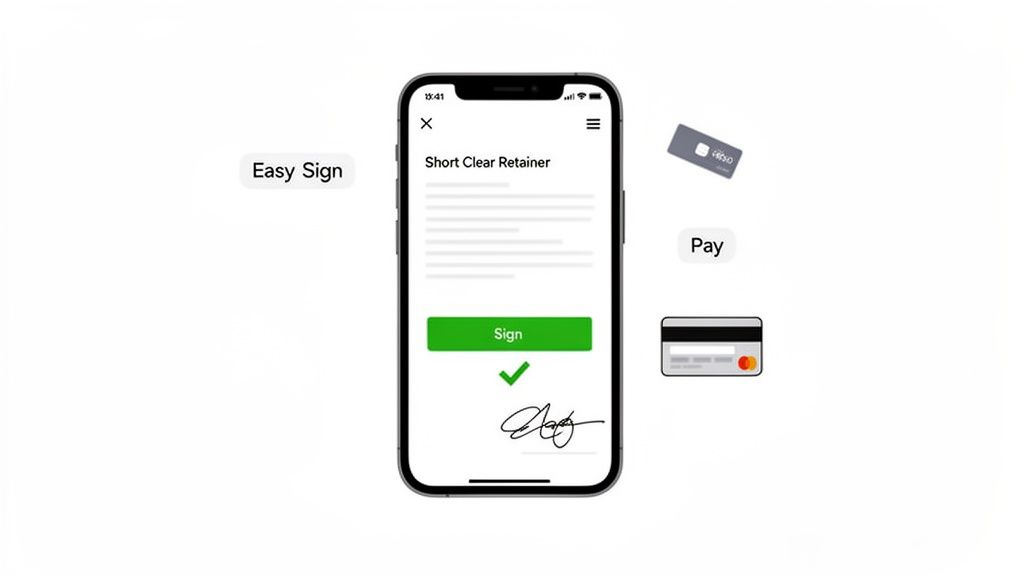
When you use clear, simple language, you start the relationship from a place of trust. Let's walk through the practical steps for drafting a better letter and getting it signed in minutes, not days.
Draft for Clarity, Not Complexity
Your potential client is likely stressed and unfamiliar with the legal system. A 15-page document packed with jargon is counterproductive. It makes them hesitant to sign something they don't understand.
Key Takeaway: Write for your client, not another lawyer. Use short sentences and simple terms. Instead of "heretofore," say "before." Instead of "execute this agreement," try "sign this letter." This small shift makes your firm feel approachable and trustworthy.
Remember, clarity prevents future disputes. The clearer your terms are today, the less room there is for a client to later claim, "I had no idea that's what it meant."
Essential Ethical Guardrails
As you simplify your language, you must still meet your professional duties. A few ethical lines are non-negotiable.
Keep these guardrails in mind:
- No Guaranteed Outcomes: Never imply or promise a specific result. Your letter should set expectations about the services you'll provide, not the outcome.
- Fee Transparency: Ambiguity around fees is a fast route to a bar complaint. Clearly state your rates, what costs are included, and what's billed separately.
- Clear Withdrawal Conditions: The letter must spell out the circumstances under which you can withdraw, ensuring it aligns with your state’s rules of professional conduct.
Getting these details right sets a professional standard from the first interaction.
Modernize Your Delivery Method: E-signatures and Payments
Stop relying on the print-sign-scan-email routine. That workflow is slow, a hassle for the client, and creates delays where a hot lead can go cold. Every extra step is a chance for them to lose momentum.
The legal industry is shifting, and client expectations are changing with it. For small firms, using e-signatures can lead to 12% conversion lifts and 20% revenue gains. When you consider that poor communication drives 35% of clients to switch lawyers, a seamless digital experience becomes a powerful way to stand out. You can discover more insights about these legal service trends to see how top firms are adapting.
Digital delivery makes it easy for a client to say "yes." With e-signatures, they can review and sign your lawyer retainer letter from their phone in minutes. You can learn more about using e-signatures in your law firm to ensure you're fully compliant. This isn't just a convenience—it's a conversion strategy.
Automate Your Retainer Process From Hours To Minutes
The gap between a client saying “yes” and you getting a signed retainer with payment is where you lose business.
Every manual step is a point of failure. The email attachment that goes to spam, the request to "print and scan," the separate call for credit card details—each one is a chance for a new client to get distracted, hesitate, or call another firm. Stop juggling scattered tools and build a single, unified workflow that makes your firm stronger.
Imagine sending one link. Your client opens it, signs the retainer, pays the deposit, and fills out their intake form, all in one seamless experience. This is how top-performing small firms operate right now. By automating this part of your intake, you eliminate the administrative drag that costs you both time and clients.
The True Cost of a Manual Retainer Process
The old way—emailing a PDF, waiting for the client to scan it, then chasing payment—is a massive conversion killer. Attorneys already spend an estimated 48% of their time on non-billable administrative tasks, and this clunky workflow is a prime offender. It's slow, inconvenient, and projects an outdated image.
This manual friction hits your bottom line directly. Speed is everything. Data shows firms using online intake achieve a 14% faster time-to-hire and see 12% higher conversions. Combine that with e-signatures, which can boost revenue by 20%, and the case for automation is undeniable. You can explore more findings from the 2024 Legal Trends Report to see the full picture.
From Disconnected Tools to a Unified Workflow
The solution is to stop thinking in separate steps and start thinking in unified workflows. Instead of separate tools for documents, e-signatures, and payments, you consolidate everything into a single action. This is the heart of modern client intake.
A unified system delivers on several fronts:
- Captures Commitment Instantly: It lets the client sign and pay the moment they decide to hire you, closing the deal before they get cold feet.
- Reduces Administrative Overhead: It ends manual tracking of documents, payment processing, and re-entering client data.
- Improves the Client Experience: It provides a simple, professional, mobile-friendly process that shows you value their time.
By sending a single link that handles the retainer letter, payment, and intake forms, you remove every point of friction. The client completes everything in one session, and the data automatically syncs to your systems.
This shift transforms your retainer process from a multi-day chore into a five-minute conversion event. You can read our guide to learn more about how to automate your client intake workflow from start to finish.
How to Implement Retainer Automation
Getting started is more straightforward than you might think. Platforms like intake.link are designed specifically for small law firms.
Here’s how it works in practice:
- Create Your Template: Upload your lawyer retainer letter template into the system once.
- Generate a Secure Link: When a new client is ready, generate a unique, secure link for them.
- Client Signs and Pays: The client opens the link, reviews the agreement, signs it electronically, and pays the retainer via credit card or ACH—all on one page.
- Data Syncs Automatically: The signed document, payment confirmation, and client information are instantly saved and synced with your case management software.
This isn't just convenience; it's a powerful strategy to lock in new business. By making it effortless for clients to hire you, you secure more of the leads you work so hard to get.
Common Questions About Lawyer Retainer Letters
Even with a solid process, you'll get questions about your lawyer retainer letter. Here are straight answers to the questions small law firm owners ask all the time.
What Is The Difference Between A Retainer And A Retainer Letter
This trips up clients constantly, so your team must be crystal clear. The "retainer" is the money—the actual fee the client pays to secure your services. The "retainer letter" (or agreement) is the document outlining the rules of the relationship, including that financial arrangement.
Think of it like this: the letter is the playbook for the game, and the retainer fee is the ticket to get in. You can't have a solid retainer arrangement without a clear, signed letter locking it all down.
Can A Retainer Letter Be Signed Electronically
Yes, absolutely. If you're not using e-signatures, you're falling behind. Electronic signatures on retainer letters are legally binding across the U.S., thanks to the federal ESIGN Act and the Uniform Electronic Transactions Act (UETA).
Using e-signatures immediately speeds up your client intake, slashes administrative work, and creates a secure audit trail. Modern intake platforms build e-signatures right into the flow. What used to take days of printing and scanning can now be done in five minutes on a smartphone.
How Should I Handle Changes To A Retainer Letter
If the scope of work changes significantly, a verbal agreement is not enough. The only right way to handle changes is with a formal, written addendum to the original retainer letter.
This new document should spell out exactly what's changing—the new scope of work, any fee adjustments—and must be signed by both you and the client. This simple step maintains clarity and shields your firm from disputes over surprise work or unexpected fees.
What Happens If A Client Disputes A Charge
This is precisely why your initial retainer letter needs to be so detailed. Your agreement must have a "Dispute Resolution" clause that specifies the process for handling disagreements, whether that’s mediation or arbitration.
When a dispute arises, go right back to the letter's terms on fees and scope. Your best defense is always airtight documentation: a well-drafted agreement paired with detailed, transparent invoices that tie directly back to those terms.
The infographic below shows how automating this process can prevent many of these issues.
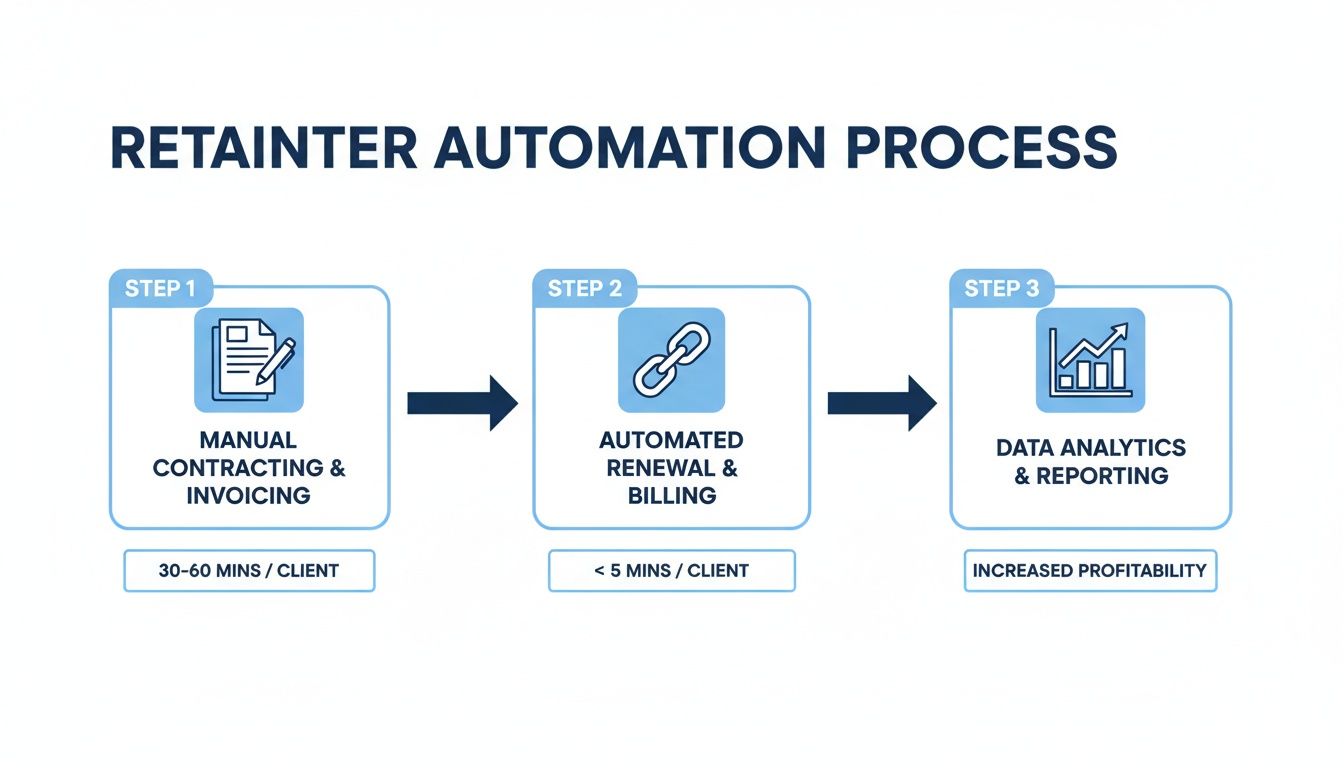
This shows the path from a clunky, manual process to a clean, automated system. It highlights how a single link removes the friction and confusion that often lead to disputes in the first place.
Stop losing leads—get signatures before they call another firm. With intake.link, you can send one link that handles the retainer letter, payment, and intake forms in a single, seamless flow. See how intake.link consolidates your entire intake process.