

Your retainer agreement isn't just a legal document—it’s the final step that turns a promising lead into a paying client before they call another firm. This guide gives you a legal retainer agreement template that closes the gap between a verbal "yes" and a signed, paid retainer, making it so easy to hire you that your competition doesn't stand a chance.
Why Your Retainer Process is Costing You Clients
You know the feeling. You finish a great consultation, the client is ready to move forward, but then… silence. That dead space between their decision and the returned paperwork is where hot leads go to die. Every minute you spend digging up a template, emailing attachments, and chasing a signature is a minute they could be talking to another firm.
Your goal isn't just to get an agreement signed; it's to bulldoze every obstacle standing between a prospect's interest and their financial commitment. Remember, leads contacted within 5 minutes are 21x more likely to convert. The key is to stop losing leads to these common delays by making the final step effortless.
Turn Your Retainer Into a Conversion Tool
Think of your retainer less like a static PDF and more like an active conversion tool. You need a modern, digital process that rolls your agreement, e-signature, and initial payment into a single, seamless link.
Your intake process is the first tangible experience a client has with your firm. A clunky, multi-step process suggests a disorganized practice, while a fast one communicates efficiency and locks in the client before they can have second thoughts.
This isn't just about convenience. It’s about using technology to ensure that once a client decides you're the right choice, the deal gets closed in minutes, not days.
The Anatomy of an Ironclad Retainer Agreement Template

Let's get straight to the point: a vague retainer agreement is just a future fee dispute. This document is the foundation of your entire attorney-client relationship. It has to be precise, comprehensive, and easy for a non-lawyer to understand.
This is your chance to prevent scope creep and set firm boundaries before work begins. Think of these clauses not as formalities, but as your first line of defense against misunderstandings and unpaid invoices. They protect your firm and build client trust right from the start.
Essential Clauses for Your Retainer Agreement Template
| Clause | Purpose | Key Consideration |
|---|---|---|
| Scope of Services | Clearly defines what you will and will not do for the client. | Be ruthlessly specific. Ambiguity here is the number one cause of scope creep. |
| Fee Structure | Details exactly how you will bill—hourly, flat fee, contingency—and when payment is due. | Leave zero room for interpretation. Specify rates, billing increments, and payment schedules. |
| Costs and Expenses | Explains that the client is responsible for out-of-pocket costs separate from your legal fees. | Itemize common costs (e.g., filing fees, expert witnesses) so clients aren't surprised. |
| Client Responsibilities | Outlines the client's obligations, such as being truthful and paying invoices on time. | This sets the expectation that the relationship is a two-way street and protects your time. |
| Communication Policy | Sets expectations for response times, business hours, and preferred contact methods. | Prevents clients from expecting instant replies to texts at 10 PM on a Saturday. |
| Termination | Defines how either party can end the engagement and what happens to any remaining funds. | This is your "escape hatch" for difficult clients and ensures a clean disengagement process. |
With that framework in mind, let's drill down into the language behind these critical sections.
Defining a Razor-Sharp Scope of Services
This is the most critical section of your entire agreement. You must explicitly state what you will do and, just as importantly, what you will not do. Don’t just write "Handle divorce proceedings." That’s an invitation for trouble.
Get specific:
- Included: Filing the initial petition, responding to discovery requests, negotiating a settlement agreement, and attending one mediation session.
- Excluded: Any appellate work, representation in related domestic violence proceedings, or QDRO preparation, which will be billed separately.
This level of detail answers client questions before they're asked and manages expectations from day one. For a deeper look, you can explore the purpose of a retainer agreement in our detailed guide.
Articulating Your Fee Structure with No Ambiguity
Money is the biggest source of conflict between lawyers and clients. Your fee section needs to be crystal clear. Whether you bill hourly, use a flat fee, or work on contingency, spell it out in plain English.
For an hourly agreement, specify:
- The hourly rate for each attorney and paralegal.
- The minimum billing increment (e.g., 0.1 or 0.25 of an hour).
- A clear statement that rates are subject to change with 30 days' written notice.
If you're using a flat fee, detail exactly what that fee covers. For instance, "$5,000 flat fee for trademark registration, with 50% due upon signing and 50% due upon filing with the USPTO."
Pro Tip: Always include a clause about costs. State that clients are responsible for out-of-pocket expenses like filing fees and expert witnesses, making it clear these are separate from your legal fees.
Outlining Client Responsibilities and Communication
A successful client relationship is a partnership. Your retainer is the perfect place to define the client's obligations, setting boundaries that protect your time and sanity.
A good "Client Responsibilities" clause should require them to:
- Be truthful and provide all relevant information.
- Respond to your communications within a reasonable timeframe (e.g., 48 business hours).
- Pay all invoices on time.
This is also where you set communication expectations. State your business hours and preferred communication method. This simple step stops clients from assuming they’ll get a response to a text at 10 PM on a Saturday.
The Termination Clause: Your Escape Hatch
Even the best-vetted client relationships can go south. A clear termination clause protects your firm if you need to withdraw.
Your clause must address two key scenarios:
- Termination by Client: The client can end the relationship with written notice but remains responsible for all fees and costs incurred.
- Withdrawal by Firm: You reserve the right to withdraw for reasons permitted by the Rules of Professional Conduct, like non-payment or failure to cooperate.
Finally, explain what happens to their money. State that any unearned portion of the retainer will be refunded to the client within a specific timeframe, such as 30 days after the final invoice.
How to Customize Your Retainer for Different Practice Areas
A one-size-fits-all retainer is a liability. The reality of a high-conflict divorce is worlds away from a straightforward business formation, and your agreement has to reflect that.
Tailoring your agreement is your first chance to demonstrate deep expertise. It shows you understand a client's specific challenges from day one, building critical confidence before you’ve logged your first billable hour.
For Family Law: High-Touch, High-Conflict
Family law is intensely personal and emotionally charged. Your retainer agreement needs to act as a fortress of clear boundaries, especially around communication.
Get painfully specific about your firm's communication policy:
- Business Hours: Define them precisely (e.g., 9:00 AM to 5:00 PM, Monday through Friday).
- Response Times: Set a reasonable expectation, like returning calls and emails within 24 business hours.
- Emergency Contact: Clearly outline what constitutes a true legal emergency and the protocol for reaching you.
This isn't about being unresponsive; it’s about preserving your sanity. A clear policy prevents burnout and keeps client expectations grounded in reality.
You should also be explicit about fees for excessive communication. A simple clause stating that communications exceeding a certain number per week may be billed can curb unnecessary contact.
For Personal Injury: Addressing Contingency and Costs
When representing a personal injury client, the contingency fee is the heart of the engagement. Your legal retainer agreement template must demystify this for clients. Ditch the jargon and use simple math.
Your agreement must draw a bright line between fees (your slice of the recovery) and costs (out-of-pocket expenses). This is a massive point of confusion that leads to disputes.
Itemize the kinds of costs the client will be responsible for, regardless of the outcome:
- Court filing fees
- Expert witness fees
- Deposition and transcript costs
- Investigator expenses
Be direct about how costs are paid. State that the firm will advance them and they will be deducted from the client’s share of the settlement after your contingency fee is calculated.
For Business and Corporate Law: Defining Success and IP
When you’re helping a startup, the scope can get fuzzy, fast. Your retainer needs to be incredibly precise to prevent "scope creep," where an entity formation project bleeds into unpaid general counsel work.
Detail the exact deliverables. For instance, a business formation covers drafting and filing articles of organization, preparing an operating agreement, and obtaining an EIN—and nothing more.
Intellectual Property (IP) ownership is another minefield. Your agreement must clearly state:
- Work Product: Who owns the final documents you create.
- Client IP: That the client retains ownership of all their pre-existing intellectual property.
Clients appreciate this clarity, especially as billing rates climb. With average partner billing rates jumping 5.4% in 2023, predictable fee arrangements are more important than ever. You can dig into the full report on recent legal market trends.
Get Paid Instantly with Integrated Signatures and Payments
The most dangerous part of your intake is the gap between a client’s verbal “yes” and a signed, paid retainer. This is where good leads go to die.
Asking a client to print, sign, scan, and email a document is a massive point of friction. Every manual step is an opportunity for that prospect to get distracted, have second thoughts, or call another firm. A clunky, paper-based process signals that your firm is outdated.
It’s time to close that gap.
From Agreement to Action in a Single Link
The goal is to turn your legal retainer agreement into a powerful conversion tool. Imagine sending a potential client one link they can open on their phone. In under two minutes, they can review the terms, sign with their finger, and pay the initial deposit.
This isn't just an e-signature field. It's a unified workflow. When signing and payment happen in the same seamless motion, you eliminate the "I'll get to that later" excuse. You capitalize on the client's momentum to lock in the engagement immediately.
Here’s what a modern, mobile-friendly e-signature process should look like.
The interface is clean and simple. The client signs directly on their device, turning a complex legal step into a quick, easy action.
Why Integrated Payments Are a Non-Negotiable
Separating the signature from the payment is a critical mistake. It creates two distinct tasks for the client, doubling the chances that one gets forgotten. An integrated system makes payment the natural next step after signing, turning a multi-day process into a two-minute transaction.
The benefits are immediate:
- Drastically Reduced Drop-Off: You capture the client at their highest point of intent, preventing them from shopping around while you wait for a check.
- Improved Cash Flow: You get paid the moment the client commits, eliminating the need to send separate invoices and chase initial payments.
- A Better Client Experience: You provide a smooth, professional onboarding experience that reflects a modern, efficient law firm.
This shift isn't just about technology; it’s about meeting client expectations. In an industry where the legal tech sector is projected to hit $35.62 billion by 2027, clients have come to expect digital convenience.
The data is clear: 71% of consumers prefer flat fees and expect to be able to pay online. By failing to offer an integrated payment option, you’re ignoring what your potential clients want. You can dive deeper into these numbers with law firm technology trends and statistics at AAG IT.
Connecting Signatures to Your Practice Management System
The final piece is automation. When a client signs and pays, a truly efficient system uses that single event to trigger a cascade of actions in the background.
With the right setup, a signed retainer can automatically:
- Create a New Matter: Instantly open a new case file in your practice management software like Clio.
- Sync Client Data: Push all the client's information from their intake form directly into the new matter, eliminating manual data entry.
- Trigger a Welcome Email: Send an automated email to the client confirming receipt and outlining next steps.
This backend automation is what separates a simple e-signature tool from a complete client conversion system. It secures the client faster and saves you hours of admin work on every new case.
Build Your Automated Client Onboarding Workflow
Having a solid legal retainer agreement template is a great start, but the real magic happens when you connect that document to an automated system that works 24/7. This is how your small firm punches well above its weight.
The goal is a single link that guides a new client from signing to paying to completing their intake. This isn't about fancy tech; it's about eliminating the delays that kill deals. Remember, leads contacted within five minutes are 21 times more likely to convert. For more on this, see how you can stop losing leads by implementing faster conversion strategies.
Upload and Prepare Your Template
First, bring your retainer agreement into a unified intake tool like intake.link. You’ll upload your document—a Word doc or a PDF—and transform it from a static file into an intelligent one.
Instead of manually typing a new client's name and address every time, you'll map fields that auto-populate from their intake form.
- Client Name: Map this to the "Full Name" question on your form.
- Case Description: Link this to the "Briefly Describe Your Legal Issue" field.
- Fee Amount: Connect this to an internal-only field you fill out before sending.
This one-time setup saves you hours of tedious work on every new client and ensures every agreement is perfectly customized.
Configure E-Signatures and Payment Processing
Next are the digital signature and payment blocks. This is the most critical step for crushing friction. You simply drag and drop signature and date fields where the client and a firm representative need to sign.
This flow chart shows the traditional friction points of getting a retainer signed and paid.
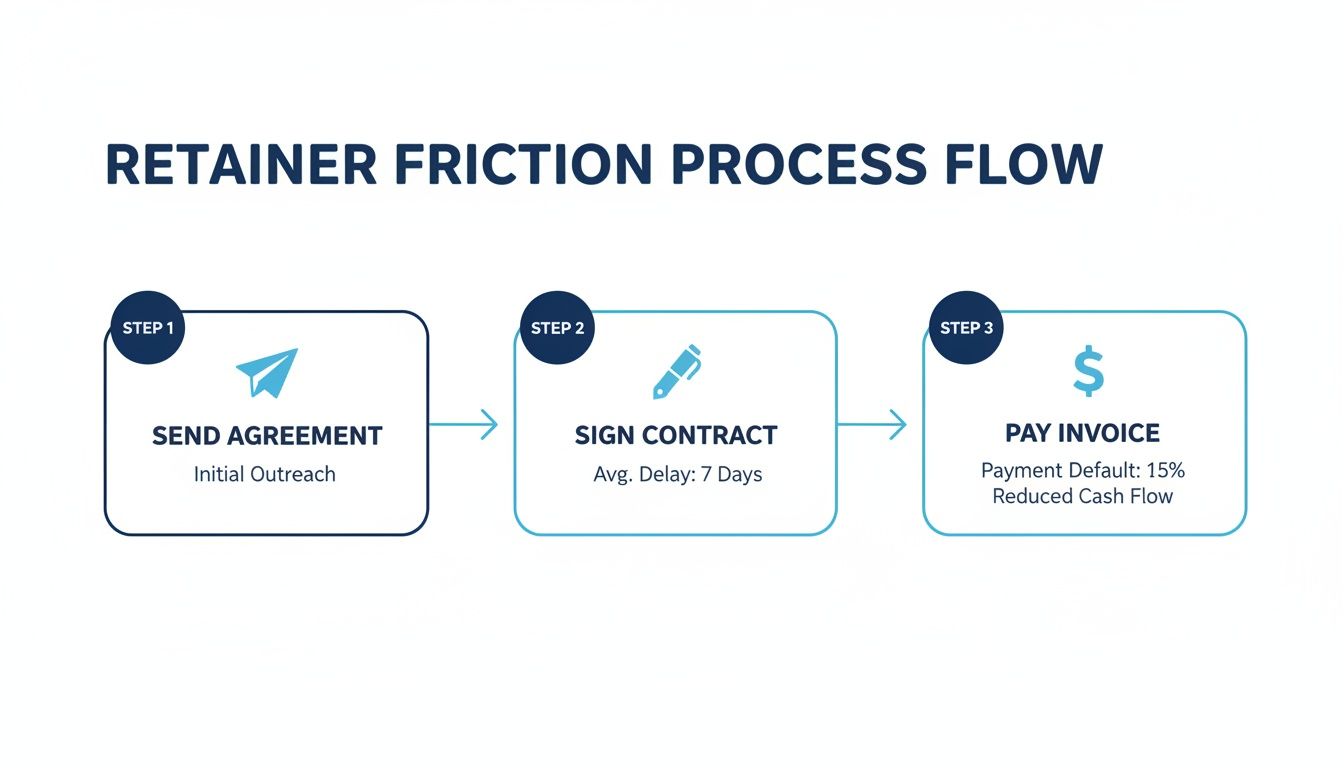
Each arrow represents a delay—a point where a client can get distracted or change their mind.
Then, you connect your payment processor, like Stripe. This allows you to require a retainer payment immediately after the signature is captured. You can set a fixed amount (a $5,000 deposit) or a variable one. The client signs with their finger, then immediately enters their credit card details.
Key Takeaway: Integrating payment isn't just an add-on; it's the core of the conversion machine. When signing and paying happen in the same flow, the client commits financially at their peak moment of intent.
Deploying Your Single-Link Intake Flow
Once your template is mapped and your payment processor is connected, you’re ready. You now have a single, powerful link that encapsulates your entire onboarding process. When a client clicks it, they move seamlessly from the agreement to payment and on to the intake form.
Manual vs Automated Retainer Workflow
The old way of onboarding clients is a minefield of delays. A modern, automated workflow collapses that entire sequence into a few minutes.
| Stage | Manual Process (The Old Way) | Automated Workflow (The intake.link Way) |
|---|---|---|
| Document Prep | Manually edit template, save as PDF, check for errors. (15-20 min) | System auto-populates template with intake form data. (0 min) |
| Sending | Draft email, attach PDF, send to client, log in CRM. (5-10 min) | Send one pre-written link via SMS or email. (1 min) |
| Client Action | Client must print, sign, scan, email back. (1-3 days) | Client reviews, signs, and pays on their phone. (2 min) |
| Follow-Up | Manually follow up via phone or email until signed. (Hours/Days) | System sends automated reminders if not completed. (0 min) |
| Data Entry | Manually enter signed client data into practice software. (10-15 min) | Data syncs automatically to your CRM upon completion. (0 min) |
The difference is stark. You are compressing a multi-day administrative headache into a two-minute transaction. This is how you reclaim time lost to non-billable work and focus on practicing law.
Keeping Your Digital Retainers Ethically Sound
Moving fast can't come at the expense of your ethical duties. Your automated retainer process must have the right compliance guardrails built in to protect both you and your clients.
Your digital retainer has to be just as clear as any paper document. The client needs a real chance to see the terms in a clean, readable format before they get to the signature block.
Nailing E-Signature Standards
Electronic signatures are legally ironclad thanks to the federal ESIGN Act. But to stay compliant, the system you use must create a bulletproof audit trail for every agreement.
That trail is your proof of consent. It should automatically log key events like:
- When the document was sent to the client.
- The moment the client viewed the agreement.
- The exact time and date the signature was applied.
- The IP address tied to the signing event.
This digital paper trail is what makes the signature defensible. For a deeper look, check out the legal requirements for e-signatures at law firms and make sure your platform ticks all the boxes.
Handling Online Payments and Trust Accounts
When you take a retainer fee online, all the usual trust accounting rules apply. That initial payment for unearned fees must land directly in your IOLTA or trust account, no exceptions. Your payment processor must be set up to route those funds to the correct account without commingling them with your operating funds.
Your ethical duty of communication extends to billing. Clients must understand what they're paying for, how the money will be held, and when those funds are considered "earned."
Getting this wrong can lead to serious ethical trouble. A report from the Association of Corporate Counsel found that 53% of corporate law departments rely on retainers for compliance and risk management. You can read more insights from their report to see how in-house teams think about this.
Your Top Questions About Retainer Agreements Answered
When you're setting up retainer agreement templates, a few questions always pop up. Here’s a straight-shot breakdown.
Are Electronic Signatures Really Legally Binding?
Yes, absolutely. Thanks to the federal ESIGN Act of 2000, e-signatures carry the same legal weight as traditional wet-ink signatures for most contracts, including retainer agreements.
The key isn’t just getting a digital scrawl; it’s using a system that proves the signer’s intent and creates a solid audit trail. A modern intake platform is built to meet these standards.
What's the Best Way to Collect the Retainer Fee After Signing?
Make the payment part of the signing process itself. Don’t send a separate link later.
By integrating a payment processor like Stripe directly into your intake flow, a new client signs the agreement and immediately enters their payment info. This one-two punch closes the loop instantly and saves you from awkward follow-up calls chasing that first check.
Can I Use Just One Retainer Template for All My Fee Structures?
You can start with a single master template for universal clauses—think confidentiality, termination, and file retention. But for the fee structure, you need distinct versions.
Your intake system should let you quickly choose the right template for the job, whether it’s for a flat fee, hourly billing, or a contingency case. Using separate, pre-approved templates ensures the terms you send out are always the right ones for that engagement.
Stop losing leads—get signatures before they call another firm. intake.link turns prospects into paying clients in minutes by consolidating your entire intake process into one link. See how our unified workflow gets retainers signed faster.