

Tired of chasing down payments or seeing promising leads go cold while you wait for paperwork? A solid retainer agreement is the answer, turning an interested prospect into a committed, paying client in minutes, not days. It’s a contract that secures payment before you start working, creating the predictable revenue your firm needs to grow.
Why a Retainer Agreement Is Your Firm’s Financial Bedrock

Think of a retainer as your client commitment engine. It's the single most important tool for building financial stability in your small practice. Without one, you’re basically working on a handshake, leaving you open to late payments, scope creep, and messy client disputes.
A well-crafted retainer agreement flips the script from a reactive "hope-I-get-paid" model to a proactive, secure one. It immediately sets the rules of the game, making sure both you and your client are on the same page about fees, communication, and the exact work you’ll be doing. This isn't just about getting paid; it's about making your client intake process a competitive advantage.
Setting Expectations and Protecting Your Time
At its core, a retainer gets you paid upfront. But its real power lies in setting crystal-clear expectations from day one. This simple document helps you:
- Define the Scope: Clearly state what services are included—and just as important, what’s not. This is your best defense against the dreaded "scope creep," where a small matter balloons into a major time sink without any extra compensation.
- Establish Payment Terms: Lay out your hourly rates or flat fees, when you’ll bill, and what happens if payments are late. This gets rid of confusion and avoids those awkward money conversations down the road.
- Make it Official: The retainer formally kicks off the attorney-client relationship, giving both of you a clear reference point for the entire engagement.
Historically, retainers were about securing a lawyer’s availability. Today, with worked rates jumping 6.5% in the first half of 2024, they've become a critical tool for managing risk and locking in revenue.
Building a Practice That Can Actually Scale
Ultimately, having a standardized retainer process is about more than just one case; it’s about building a sustainable business. When you have a reliable system for bringing on new clients, you create predictable revenue.
That financial stability is what allows you to forecast your firm’s growth, make smarter hiring decisions, and invest in tools that make you more efficient. Every agreement you sign strengthens this foundation. As our guide on using a CRM for law firms explains, managing these relationships starts with a solid onboarding process.
A great retainer is your first step toward building a practice that doesn't just survive—it thrives.
Retainer Agreement at a Glance
For a quick summary, here's a simple breakdown of the core parts of any effective retainer agreement.
| Component | What It Does | Why It's Critical for Your Firm |
|---|---|---|
| Scope of Services | Defines the exact work you'll perform and what's excluded. | Prevents scope creep and ensures you're paid for all your work. |
| Fee Structure | Details how you'll be paid (hourly, flat fee, etc.). | Creates transparency and eliminates billing surprises. |
| Payment Terms | Specifies the retainer amount, due dates, and billing cycle. | Secures upfront payment and establishes a predictable cash flow. |
| Termination Clause | Outlines how either party can end the engagement. | Provides a clear, professional exit strategy if the relationship ends. |
| Client Responsibilities | Lists what you need from the client (e.g., timely info). | Sets expectations for collaboration and keeps the case moving. |
This table covers the essentials, but a truly effective retainer is one that's integrated seamlessly into your intake process, making it easy for clients to sign and pay in one go.
The Four Main Types of Legal Retainers

Picking the wrong retainer model is a fast track to billing disputes and unhappy clients. To protect your firm and build predictable revenue, you have to match the agreement to the work.
Let’s break down the four most common retainer types so you can choose the right one for every engagement. Getting this right from the start creates a stable financial foundation for your firm.
1. General Retainer
Think of a general retainer as putting your firm on speed dial. A client pays a set, recurring fee simply to secure your availability. This fee isn’t tied to a specific project or a bucket of hours; it’s about having you on standby.
This fee is considered earned on receipt. Because it’s paying for access to you—not for work you haven’t done yet—it goes directly into your firm’s operating account. No trust account needed.
- Real-World Example: A local tech startup pays your firm a flat $2,500 per month to act as their on-call counsel for quick contract reviews and compliance questions.
- Best for: Business law, corporate counsel, or any practice where clients need ongoing, on-demand legal guidance.
- Key Advantage: It creates a stable, predictable monthly revenue stream you can count on.
2. Special Retainer
The special retainer is the workhorse of the legal world. A client pays a lump sum upfront for a specific, defined legal matter, like a divorce or a personal injury case.
Crucially, this is an unearned retainer because you haven't performed the work yet. That means the funds must be deposited into a client trust account (IOLTA). As you bill hours, you transfer the earned portion from the trust account to your operating account.
Trust Accounting Is Non-Negotiable: Mishandling unearned retainer funds is one of the fastest ways to face disciplinary action. Always deposit advance payments for specific work into a designated client trust account until you have earned them.
This model is perfect for matters with a clear beginning and end.
3. Evergreen Retainer
The evergreen retainer is a smarter, more cash-flow-friendly version of the special retainer. It’s designed to prevent a client's account from running dry in the middle of a complex case.
With an evergreen model, the client must replenish the funds in their trust account whenever the balance drops below a pre-agreed threshold. This ensures you always have a financial cushion and never have to stop work while waiting to get paid.
- Real-World Example: You take a litigation case with a $10,000 initial retainer. Your agreement specifies that the client must top up the account back to $10,000 anytime the balance falls below $2,500.
- Best for: Long-term litigation, complex family law cases, or any matter with unpredictable monthly costs.
- Key Advantage: It guarantees you are always working with funds in hand, dramatically improving your firm's cash flow.
Clauses Every Retainer Agreement Must Include
A vague retainer agreement is a future client dispute waiting to happen. To protect your firm, your agreement needs to be an ironclad document that sets expectations, prevents scope creep, and makes sure you get paid.
This isn't about stuffing it with dense legalese; it's about creating absolute clarity from day one. Getting these clauses right isn't optional—it's essential for a healthy practice.
Scope of Representation
This is the most critical clause in your entire agreement. It draws a bright line around what you will do and, just as importantly, what you will not do. Without a well-defined scope, a simple matter can quickly balloon into a time-sucking project you aren't being paid for.
Be ruthlessly specific. Instead of "handle the business formation," break it down: "drafting and filing Articles of Organization, securing an EIN, and preparing the initial operating agreement."
Pro Tip: Add an "Exclusions" subsection. Explicitly state the services that are not included. For example, "This representation does not include litigation, appeals, or any post-judgment collection activities."
This level of precision protects your time and profitability.
Fee Structure and Payment Terms
Clarity around money prevents the most common client conflicts. This clause must detail your fee structure—whether it's hourly, a flat fee, or a hybrid model. It should also specify the exact retainer amount required to get started.
Your payment terms section should also clearly outline:
- Billing Frequency: "Invoices will be sent on the last business day of the month."
- Replenishment Terms: For an evergreen retainer, state the minimum balance and the top-up amount. For example, "Client agrees to replenish the retainer to its original $5,000 amount within seven days whenever the balance falls below $1,500."
- Late Payment Penalties: Specify any interest or fees for overdue invoices, compliant with your state bar rules.
Formalizing these terms is key. In fact, 71% of clients say they prefer flat fees, and firms using online payments collect 33% more. You can explore more legal industry trends and understand why streamlining payments is critical for firm health.
Client Responsibilities and Communication
A successful attorney-client relationship is a two-way street. Your client has responsibilities, too, and your agreement is the place to outline them.
This section should require the client to:
- Provide Information Promptly: State that the client must supply all necessary documents in a timely manner.
- Be Truthful: Require the client to provide complete and accurate information.
- Remain Available: Specify that the client must be reachable for important decisions.
It’s also smart to define your firm's communication policy here. Do you respond to emails within one business day? Setting these boundaries upfront manages expectations and protects your own focus time.
Termination and Withdrawal
Every engagement eventually ends. Your agreement must provide a clear, professional off-ramp for both you and the client, protecting your firm if the relationship sours.
Include conditions for withdrawal compliant with your jurisdiction's rules of professional conduct. You’ll need to outline how the final billing will be handled and state that any unearned funds held in trust will be promptly returned.
How to Get Retainers Signed and Paid in Minutes
Every hour you make a potential client wait for your retainer is an open invitation for them to call another firm. Remember, 67% of clients choose the first firm that responds professionally.
The old way—emailing a PDF, waiting for a printout, a scan, and a separate payment—actively costs you clients. It’s slow, clunky, and gives leads plenty of time to second-guess their decision. The modern workflow smashes through these delays by sending one link for intake, signature, and payment.
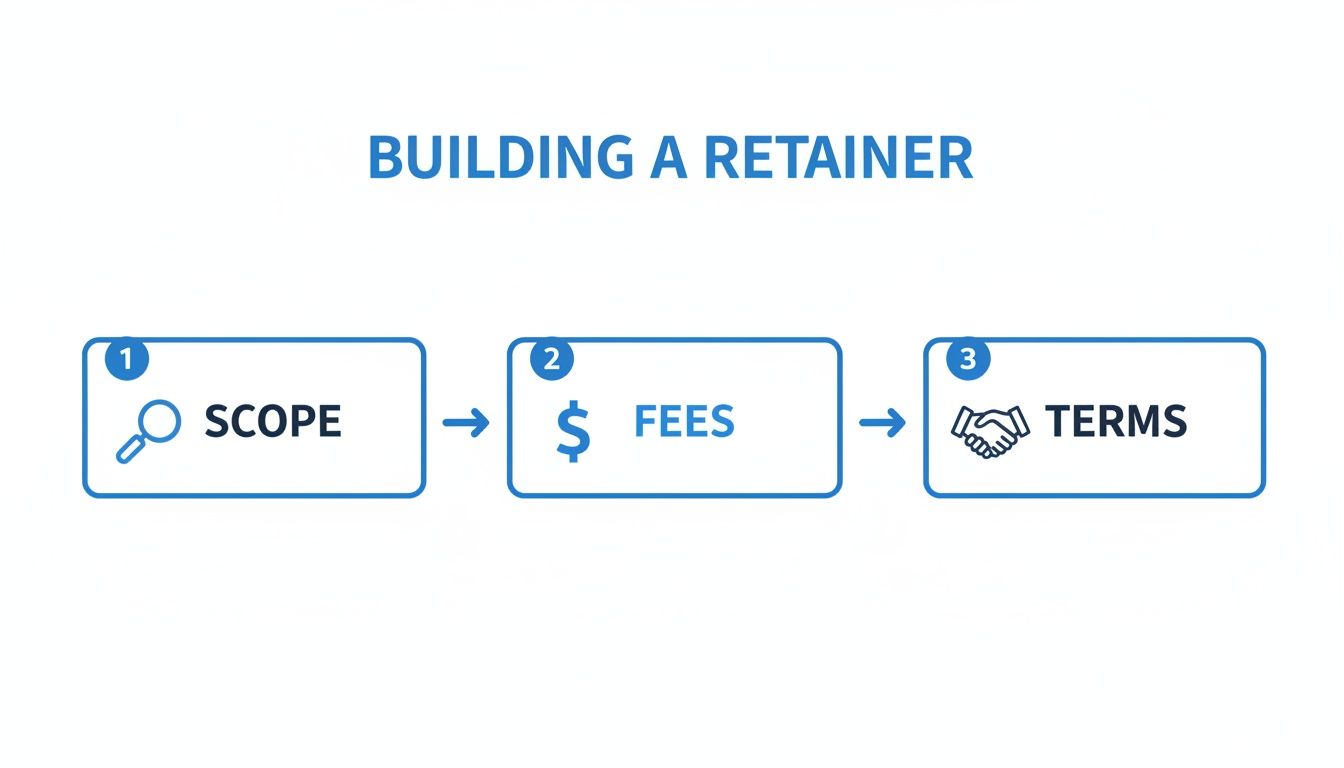
This entire process can take minutes, not days. It closes the gap between the client saying "yes" and you having a secured, paying client in your system.
The One-Link Workflow Explained
The goal here is simple: remove every possible obstacle. Instead of forcing clients to juggle three different tools (a form builder, an e-signature platform, and a payment processor), you bring it all together.
Here’s how it works in practice:
- Build Your Template: You set up your standard retainer agreement and the matching intake form just one time.
- Generate a Secure Link: When a new lead is ready, you generate a unique, secure link just for them.
- Client Does Everything at Once: The client opens the link and is guided through a simple workflow. They fill out their info, sign the retainer on their phone, and enter their card details to pay the deposit.
This entire sequence can happen before you even hang up the phone from your initial consultation.
Why This Unified Approach Wins More Clients
The traditional process is slow and riddled with drop-off points. A client might struggle to print the document or get sidetracked before making the payment. Each delay increases the odds you’ll lose the business.
A unified system prevents this by capturing their commitment and payment at the peak moment of intent. It transforms your retainer agreement from a static document into a powerful conversion tool.
This isn't just about convenience; it's a competitive advantage. While other firms are stuck in a cycle of follow-up calls, you’re already onboarded and starting work.
By integrating these steps, you also eliminate hours of manual admin work. There's no need to chase signatures or manually copy client data from a PDF into your system. Optimizing your client intake forms is the first step, and you can start with our guide to building a better legal client intake form.
Common Retainer Agreement Mistakes To Avoid
A poorly written retainer agreement is a ticking time bomb that can lead to client disputes, payment headaches, and even ethical complaints. Many lawyers fall into common traps that cost them money and create unnecessary friction.
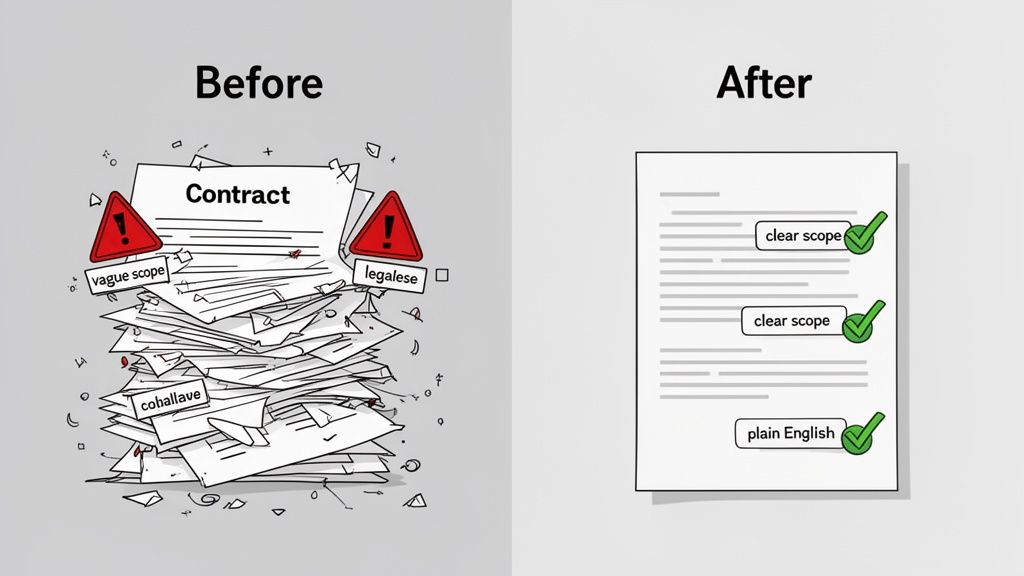
Fixing these mistakes isn’t just about covering your bases. It’s about creating a clear, professional client experience from the moment they decide to hire you. Let’s break down the most frequent errors and how to fix them.
Mistake 1: Vague Or Open-Ended Scope Of Work
This is the single biggest mistake you can make. Failing to define the scope of representation with absolute precision is a direct invitation for scope creep. When the lines are blurry, clients will naturally assume more work is included, killing your profitability.
Before (Dangerously Vague): "Attorney will represent Client in their business formation matter."
What does that even mean? Does it include trademark searches or reviewing a commercial lease? A client might think so. You have to draw clear boundaries.
After (Crystal Clear): "Representation is limited to the drafting and filing of Articles of Organization, obtaining a federal EIN, and preparing a standard single-member operating agreement. Any services beyond these, such as contract review or intellectual property filings, are excluded and will require a separate engagement."
This language leaves zero room for misunderstanding.
Mistake 2: Confusing Fee And Billing Language
Remember, your clients are not lawyers. If your payment terms are hard to follow, you’re creating friction right out of the gate and making it harder to get paid on time.
Your retainer agreement is an onboarding tool, not just a legal shield. Clarity inspires confidence and gets you paid faster.
Instead of hiding behind complex clauses, use simple, direct language.
- Avoid This: "The fee for services rendered shall be billed against the initial retainer deposit, with invoices generated periodically at the Firm's discretion."
- Use This: "We will bill our time against your $5,000 retainer deposit at a rate of $350/hour. You will receive an itemized invoice on the last business day of each month."
That simple change replaces ambiguity with certainty, which every client appreciates.
Mistake 3: Failing To Set Communication Expectations
A huge percentage of client frustrations stem from mismatched expectations around communication. Your retainer agreement is the perfect place to set these boundaries from day one, which protects your focus and ensures a professional working relationship.
Don't leave your communication policies unstated. Be explicit.
- What to Include:
- Response Times: "We will respond to all emails and phone calls within one business day (24 hours)."
- Best Contact Method: "For non-urgent matters, please email us to schedule a call. This allows us to give your issue our full attention."
- Emergency Contact: Provide clear instructions for what constitutes an emergency and how to reach you.
Setting these expectations upfront stops clients from feeling ignored and prevents you from feeling pressured to be available 24/7. When you clarify what a retainer agreement covers in terms of your availability, you dramatically reduce future conflict.
Common Retainer Pitfalls vs Best Practices
Many common mistakes can be avoided by thinking through potential friction points before they happen. Here’s a quick look at the most frequent pitfalls.
| Common Mistake | Potential Consequence | How to Fix It |
|---|---|---|
| Ambiguous Scope | Scope creep, unpaid work, client disputes. | Define exact services included and, just as importantly, what is excluded. Use a detailed list. |
| Complex Fee Terms | Payment delays, client confusion, loss of trust. | Use plain English. Clearly state rates, billing cycles, and how the retainer is replenished. |
| No Communication Policy | Unrealistic client expectations, constant interruptions, burnout. | Set clear response times and preferred contact methods directly in the agreement. |
| Unclear Termination Clause | Disputes over final bills, files, and post-engagement duties. | Detail the process for ending the relationship, including notice periods and final payments. |
By addressing these issues proactively in your retainer agreement, you’re not just protecting your firm—you’re setting the foundation for a professional client relationship from the start.
Frequently Asked Questions About Retainer Agreements
You’ve built the perfect retainer, but the real world always throws a few curveballs. Here are straight, no-nonsense answers to the questions that pop up when you're managing retainers day-to-day.
Getting these details right isn't just about compliance—it's about managing client expectations and protecting your firm’s cash flow.
What Happens to Unused Funds in a Retainer Account
Simple: you give it back. Any money left over from an advance-fee retainer held in your trust account must be returned to the client when the work is done. This isn't just good practice; it's a non-negotiable ethical rule.
Your retainer agreement should make this crystal clear. Spell out the process for the final accounting and the prompt refund of their remaining balance. That transparency builds lasting client trust.
How Is a Retainer Agreement Different From a Flat Fee
This is a common mix-up, but the distinction is straightforward. Think of the retainer agreement as the master contract—it's the document that establishes the attorney-client relationship and all its rules.
A flat fee is just one type of payment structure that can live inside that agreement. For example, a client might pay a $5,000 flat fee for a simple incorporation. That money goes into your trust account, and the retainer agreement is the document that defines exactly what work is covered by that flat fee.
Can I Start Work Before the Retainer Is Signed
The short answer is no. You should never start any substantive legal work until that agreement is signed and the retainer deposit has cleared. Period.
Working without a signed retainer is like driving without insurance—you’re exposing your firm to massive risk. You open yourself up to disputes over the scope of work, and you'll have a nightmare trying to get paid for your time.
A signed agreement protects everyone. It formalizes the relationship and sets the ground rules from the very beginning. Your goal should be to make the signing and payment process so seamless that you're never tempted to jump the gun.
Are E-Signatures Legally Binding for Retainers
Absolutely. Electronic signatures are fully valid and legally binding for retainer agreements across the United States. Thanks to the federal ESIGN Act and the Uniform Electronic Transactions Act (UETA), they have the same legal force as a traditional "wet ink" signature.
For a small firm, using e-signatures is a total game-changer. It cuts out the tedious cycle of printing, signing, and scanning. You can get a signed agreement back in minutes, which dramatically cuts down the chances of a hot lead going cold.
How Do I Handle a Client Who Disputes a Bill Against Their Retainer
Your signed retainer agreement is your first and best line of defense. It should clearly spell out your rates and billing practices, leaving zero room for interpretation. When a dispute pops up, the first step is to give the client a detailed, itemized invoice that shows exactly where every dollar went.
From there, it’s all about communication. Listen to their concerns calmly and professionally. Most billing disputes come from a simple misunderstanding, and you can often clear things up just by walking them through the invoice and pointing back to the terms they already agreed to.
Ready to stop chasing signatures and payments? intake.link consolidates your entire onboarding process into one seamless link. Get retainers signed, deposits paid, and intake forms completed in minutes—before a lead has time to call another firm.