

Tired of chasing down payments and dealing with unpredictable cash flow? Understanding how a lawyer retainer works is the key to your firm's financial stability. It's an upfront payment from a client that secures your services, ensuring you have the resources to start work immediately without dipping into firm funds.
What a Lawyer Retainer Is and Why It Matters

Understanding how a lawyer retainer works is fundamental to your small firm's financial health. Think of it like fueling up your car before a road trip; it guarantees the journey can begin immediately and run smoothly. This is a critical piece of your complete guide to law firm client intake.
By collecting funds at the start, you instantly filter for serious clients and protect your most valuable asset: your time. A retainer transforms a hopeful prospect into a committed partnership. It sets a professional tone and gives the client peace of mind, knowing you are officially on their side.
Securing Your Firm’s Financial Health
For a small law firm, predictable cash flow is everything. Retainers deliver that. As you complete work, you draw earned fees from the retainer held in a trust account, which guarantees you get paid.
With average lawyer hourly rates climbing 28% since 2016 to $327, securing funds upfront through a retainer is no longer a luxury—it’s a core operational necessity for managing your cash flow.
This structure eliminates the stress of chasing invoices after the work is done. It frees you to focus on practicing law instead of playing collections agent. For more details, see our complete guide on what a retainer agreement is.
The Retainer Process At a Glance
Let’s walk through the process from both your firm's and your client's perspective. Each step is designed to build trust and keep things transparent.
Here's a quick overview of the core components of the lawyer retainer process.
| Step | What It Means for Your Firm | What It Means for Your Client |
|---|---|---|
| Agreement | You define the scope of work and fee structure, ensuring clarity and preventing scope creep. | They understand exactly what services are covered and how much they will cost. |
| Payment | You receive an upfront deposit, securing payment for future work and validating client commitment. | They secure your availability and officially engage you as their legal counsel. |
| Billing | You invoice against the retainer for hours worked, transferring earned funds from trust to operating. | They receive clear, itemized statements showing how their funds are being used. |
| Conclusion | You return any unearned funds at the end of the engagement, reinforcing trust and professionalism. | They receive a refund for any unused portion of the retainer, ensuring fairness. |
As you can see, the retainer model is built on mutual respect and clear expectations, setting the foundation for a strong attorney-client relationship.
Choosing the Right Type of Retainer Agreement
Not all cases are the same, and your retainers shouldn't be either. Picking the right retainer model for a case improves your firm's profitability and stops client misunderstandings before they start. It’s the difference between smooth billing and constant payment headaches.
Your goal is to match the retainer type to the work. A simple business incorporation has different needs than a complex commercial dispute. Using the wrong structure leads to confused clients and cash flow problems for your firm.
Advance Fee Retainers for Predictable Work
This is the classic model: the advance fee retainer. Your client pays a deposit for future legal services, and you place those funds into a trust account. As you complete work, you draw down from that balance.
This structure is a perfect fit for matters with a variable but defined scope, like a family law case or a contract negotiation. It guarantees you have funds in hand before the work begins.
Evergreen Retainers for Ongoing Litigation
When you’re gearing up for a long, complex case, an evergreen retainer is non-negotiable. It’s an advance retainer with an automatic refill clause. When the client’s trust account balance drops below a specific amount (say, $2,500), they are required to deposit more funds.
This model is your single best tool for managing cash flow during protracted litigation. It prevents you from financing a case out of your firm's operating account and ensures you never have a zero balance at a critical moment.
Pro Tip: Your evergreen clause needs to be crystal clear in your agreement. Specify the minimum balance that triggers the replenishment and the exact amount required. This avoids arguments when it's time for the client to add funds.
Flat-Fee Retainers for Standardized Services
A flat-fee retainer is a fixed price paid upfront for a well-defined scope of work. This model is perfect for routine services where you can accurately estimate your time.
Common uses include:
- Uncontested divorces
- Basic estate planning
- Standard contract drafting
- Business formations (LLCs, incorporations)
Clients love the cost certainty of flat fees, which can be a powerful marketing advantage. Learn more about how to structure these by reading about the lawyer retainer fee.
Comparing Retainer Types for Your Practice
Choosing the right model sets clear expectations and builds trust. This table provides a quick side-by-side comparison to help you decide which retainer is best for different legal services.
| Retainer Type | Best Used For | Key Benefit for Your Firm |
|---|---|---|
| Advance Fee | Matters with a variable workload, like contract negotiations or general counsel services. | Guarantees funds are available before you begin work on a specific matter. |
| Evergreen | Long-term, ongoing cases such as complex litigation or lengthy corporate disputes. | Ensures a continuous source of funds, protecting your firm's cash flow during protracted engagements. |
| Flat-Fee | Standardized, predictable services like basic estate planning or business incorporations. | Attracts clients with price transparency and simplifies your billing process for routine tasks. |
The right retainer protects your firm while giving your client clarity. By mastering these options, you can tailor your agreements to each client and case.
Managing Client Funds in Trust vs. Operating Accounts
If there's one rule that can save your license, it's this: client money is not your money. Mixing unearned client retainers with your firm’s revenue isn’t a sloppy accounting mistake; it's an ethical breach that the state bar takes very seriously.
Understanding how a retainer works starts with this non-negotiable principle. Every state has strict regulations requiring you to keep client funds separate from your own. Fail to comply, and you risk serious disciplinary action.
The Two-Account System Every Firm Needs
To manage retainers properly, you must operate with two specific types of bank accounts. The confusion between them is where many firms get into trouble.
Trust Account (IOLTA): This is where all unearned client funds live. When a client pays a retainer, that money belongs to them until you’ve done the work. It sits in this dedicated account, untouched, until you earn it.
Operating Account: This is your firm’s business account. It holds money you have actually earned. You use this to pay salaries, rent, and other expenses. You only move money from the trust to your operating account after you’ve invoiced the client.
This simple flowchart breaks down how different retainers flow through this two-account system.
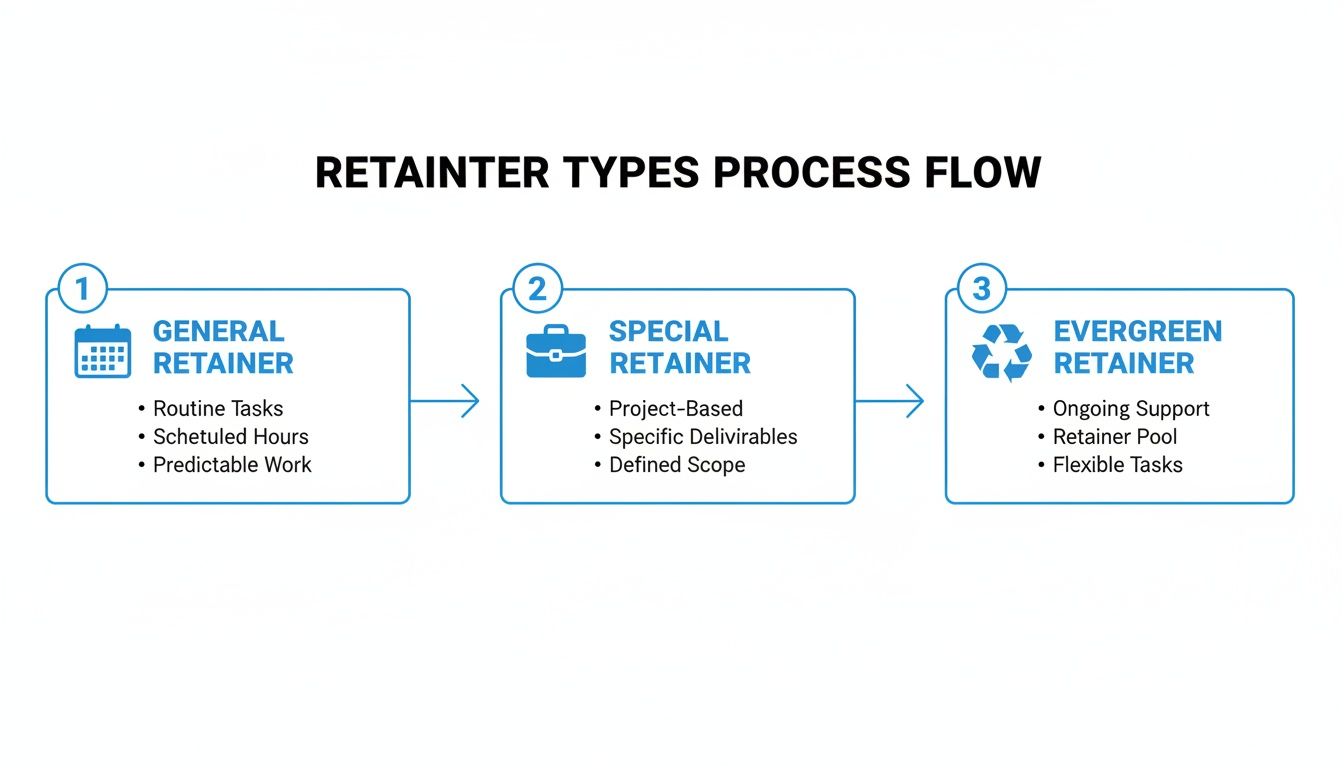
As the visual shows, whether it's a general, special, or evergreen retainer, the initial funds are treated as an unearned liability—money held in trust for the client.
A Simple Money Flow Example
Let’s make this practical. A new client pays a $5,000 retainer. Here's what happens next:
- Deposit: The entire $5,000 is deposited directly into your firm’s IOLTA or trust account.
- Work: You log 10 billable hours at your rate of $300/hour.
- Invoice: You send the client a detailed invoice for $3,000.
- Transfer: Only after the invoice is sent do you transfer $3,000 from the trust account into your operating account. That money is now earned revenue.
- Balance: The remaining $2,000 stays in the trust account to cover future work.
This process is the only compliant way to handle advance fee retainers. The invoice is the critical trigger that converts unearned client funds into earned firm revenue. Getting this flow right protects your clients' money and your firm's ethical standing.
Essential Clauses for an Ironclad Retainer Agreement
Your retainer agreement is your best line of defense. It stops scope creep, heads off billing disputes, and ensures you get paid. A vague agreement is an invitation to conflict; a strong one protects your firm and establishes professional boundaries from the start.
This isn't a modern quirk. The idea dates to 18th-century England, where a fee guaranteed a barrister wouldn't work for the other side. Today, retainers are the financial backbone for 80% of small firms, with initial amounts often between $3,000 and $10,000 for civil cases.
Defining the Scope of Representation
This is the single most important clause. You must spell out precisely what you will do and what you will not do. If you fail here, that "simple contract review" can morph into a full-blown negotiation you never priced for.
Get specific. Don't write "handle the business sale." Instead, write "draft and negotiate the Asset Purchase Agreement and all associated closing documents for the client's sale of ABC Corp." Clarity prevents misunderstandings that lead to unpaid work.
Clarifying the Fee Structure
Money is where relationships break down, so leave zero room for interpretation. Your fee clause must list the exact hourly rates for everyone who might touch the file—partners, associates, and paralegals.
Do you bill for expenses like photocopies or court filing fees? List them. There is no faster way to destroy trust than surprising a client with unexpected charges on their first invoice. Be transparent.
The Evergreen Replenishment Clause
For any case that isn't a flat-fee matter, the evergreen clause is a lifesaver. This clause requires the client to maintain a minimum balance in their trust account. When the balance dips below that threshold (say, $2,500), the client is contractually obligated to top it back up.
Think of this as your financial backstop. This clause prevents you from financing a client's litigation from your own pocket. It ensures you always have funds on hand to cover upcoming depositions or expert fees without touching your operating cash.
The Termination Clause
Every engagement needs a clear off-ramp. The termination clause outlines how either party can end the relationship professionally.
This section should cover what happens to the client’s files, how the final bill gets paid, and the process for returning any unearned funds from the trust account. It provides a clean exit strategy. You can see more examples in our legal retainer agreement template.
Automating Your Retainer Process to Convert Leads Faster
How many clients have you lost while they find a printer, sign a PDF, and mail a check? Every hour you wait is an invitation for a hot lead to call another firm. Since 67% of clients choose the first firm that responds professionally, speed is everything.
The old way of emailing documents, waiting for the postman, and manual data entry is a conversion killer. It creates friction and gives potential clients time for second thoughts. Your goal is to tear down every barrier between a prospect saying "yes" and becoming a signed, paying client.
One Link to Sign, Pay, and Onboard
What if you could send a potential client one secure link that lets them do everything from their phone in under five minutes? That's the modern solution.
- E-Sign the Retainer: They can review and sign your agreement on the spot. No printers, no scanners.
- Pay the Deposit: They can enter their credit card details immediately, securing the funds.
- Complete Intake: They provide essential case information through a simple, mobile-friendly form.
This is what a seamless, unified intake process looks like. One link, one short process, one new client.

When a client can e-sign and pay on the same screen, you eliminate the delays that kill deals. By combining these steps into a single flow, you dramatically shrink the window where a lead can drop off before committing.
Turning Speed into Profitability
This isn’t just about making things easy; it’s about your firm's bottom line. Upfront retainers are a huge driver of profitability, yet many firms still lose up to 30% of their qualified leads because their intake process is clunky.
Automating with a tool like Intake.link closes that gap. You can capture an average deposit of $2,500 and get a signed agreement before the prospect has a chance to cool off, let alone shop around. The latest legal trends research backs this up.
Stop losing good leads in the paperwork shuffle. Get the signature and the payment before they have a chance to call someone else.
Your Top Questions About Lawyer Retainers, Answered
Even experienced lawyers run into gray areas with retainers. This isn't just about getting paid; it's about ethics, client trust, and setting clear expectations from day one.
Here are the most common questions from firm owners, with straightforward answers you can use immediately.
Is a Retainer Fee Refundable?
Yes, almost always. Let’s cut through the noise: you cannot keep unearned money. That’s the golden rule.
If a case wraps up with cash left in the client’s trust account, it goes back to the client. Period. You are ethically bound to return it promptly. This gets to the heart of how a lawyer retainer works—it's a deposit against future work, not a payment for simply taking the case.
How Much Should a Retainer Be?
There's no magic number, but a solid rule of thumb is to estimate the first 30-60 days of work. This gives you a financial cushion to get the case off the ground without sending an invoice in week two.
Think through these factors:
- Case Complexity: A contentious divorce demands a much larger retainer than an uncontested one.
- Your Hourly Rate: The retainer should cover a real block of your time—maybe 10-20 hours to start.
- Anticipated Costs: Factor in initial costs like filing fees or expert consultations.
For most small firms, retainers land somewhere in the $3,000 to $10,000 range. The key is to justify the number based on the work you anticipate.
How Do You Explain Retainers to a Client?
Keep it simple. Ditch the legalese and focus on how it benefits them. Frame it as their way of securing your dedicated time and making their case a priority.
Client-Friendly Script: "Think of the retainer like a security deposit for our time. The funds go into a special, protected trust account, and we only draw from it as we complete work on your case. Every month, you'll get a detailed statement showing exactly what we did, so you're always in the loop."
This approach builds trust and makes the retainer feel like a tool for transparency, not just another fee. Explaining it with confidence heads off future misunderstandings.
What Happens When a Retainer Runs Out?
This comes down to your retainer agreement. For any case that isn't a flat fee, an evergreen clause is non-negotiable. This is the part of your agreement requiring the client to maintain a minimum balance in their trust account.
When the account dips below that threshold, the client is contractually obligated to replenish it. This simple mechanism prevents you from working for free or funding the litigation yourself.
See how intake.link consolidates your entire intake process. intake.link turns inquiries into paying clients in minutes with one simple, secure link for e-signatures, payments, and forms.