

Had a great consultation where the client said "You're hired!" only for them to disappear? You’re left chasing a signature and waiting on a check, wondering if they’re already talking to the firm down the street. That gap between a verbal "yes" and a signed, paid agreement is where motivated leads go to die.
This guide breaks down everything you need to know about the retainer cost lawyer fees, but more importantly, it shows you how to close that gap and get paid the moment a client decides to hire you. Stop losing clients to administrative friction.
How to Stop Chasing Retainers and Start Closing Clients
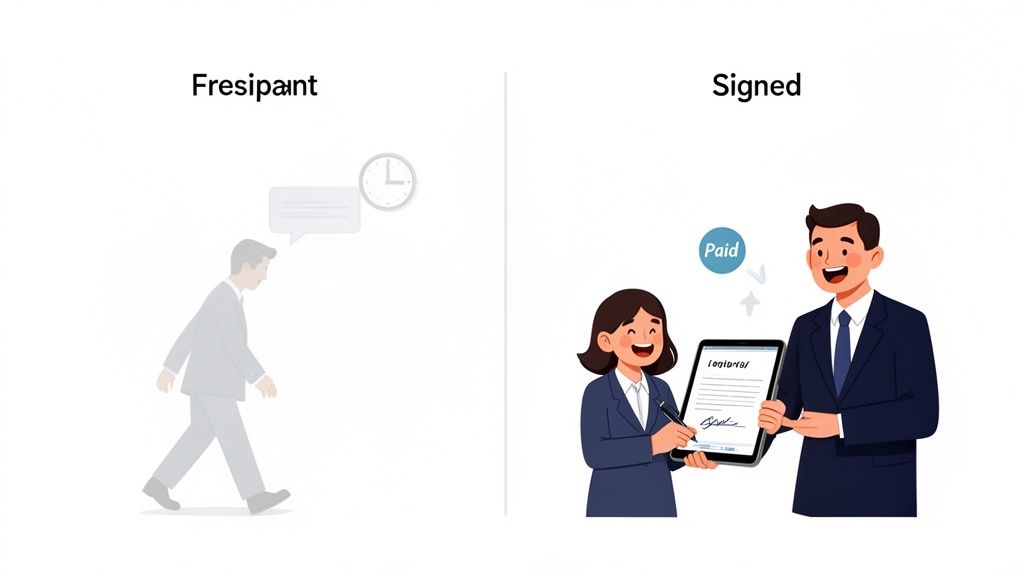
Every hour spent printing, scanning, and waiting for the mail gives a new client time to get cold feet. This administrative lag introduces uncertainty and gives a motivated person a reason to keep shopping around. Your goal is to shrink that timeline from days to minutes.
When you make it dead simple for a client to commit, they will—often right on the spot.
The Real Cost of a Slow Intake Process
In lead conversion, speed is everything. We know from industry data that leads contacted within 5 minutes are a staggering 21x more likely to convert. But that initial speed is wasted if your retainer process is slow and clunky. You did the hard work of getting them on the phone, only to reintroduce the very delay you tried to avoid.
This is your chance to stop losing leads by closing the gap between the consultation and the payment. You secure the client before their motivation fades or a competitor swoops in.
Your ability to get a retainer signed and paid within minutes of a client's decision is your single greatest competitive advantage. It’s not just about efficiency; it's about capturing commitment at its peak.
Of course, a seamless process is only half the battle. Building trust and clarity around fees through solid client communication best practices is just as critical.
What a Legal Retainer Actually Is (And How to Explain It)
Let's be direct: clients are often confused by retainers, and that confusion can kill a potential engagement. Your job is to demystify your fees right from the first consultation.
Explain a retainer as a down payment for your future work, not a fee you’ve already earned. It secures your availability. That money is held in a special trust account, separate from your firm's operating funds. As you earn your fees, you transfer funds from the trust to your business account. This simple explanation builds trust instantly.
The Three Types of Lawyer Retainers
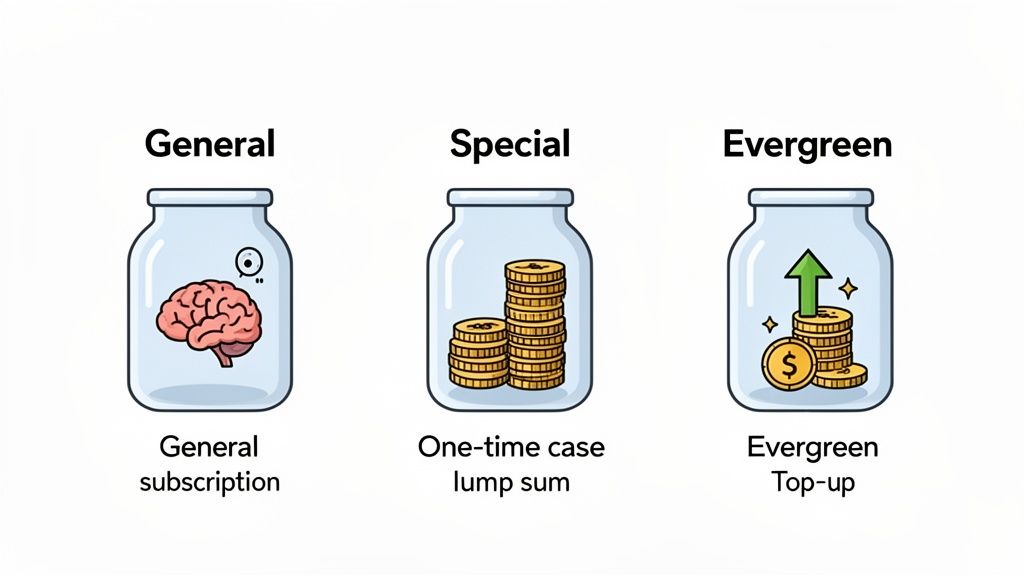
Using simple analogies helps clients grasp these concepts, making them more comfortable signing. Most small firms use one of three models. Knowing which to use—and how to explain it—is crucial.
You can learn more in our complete [lawyer retainer definition](https://intake.link/blog/intake/lawyer- retainer-definition) guide, but here's a quick breakdown:
Special Retainer: The most common type. A client pays a lump sum upfront for a specific case, and you bill against it. The simple explanation: "It's like a pre-paid gift card for your legal services, dedicated to this case only."
General Retainer: This works like a subscription. A client pays a recurring flat fee (usually monthly) to keep you on call for advice. The simple explanation: "This keeps us on your team, ready to help whenever you need it."
Evergreen Retainer: A special retainer with a top-up rule. When the balance dips below a certain floor (e.g., $1,000), the client replenishes it. The simple explanation: "This ensures your case never loses momentum due to billing issues."
By framing the retainer as a simple, pre-paid arrangement, you remove financial uncertainty. This clarity is a critical part of a smooth client intake process that turns consultations into paying clients without delay.
Typical Lawyer Retainer Costs by Practice Area
Figuring out what to charge for a retainer feels like a balancing act. Charge too high, and you scare off good clients. Charge too low, and you undervalue your work and starve your firm of cash flow.
Knowing the going rate in your practice area gives you a data-backed starting point for a confident pricing conversation.
Across the country, initial retainers for common legal matters land between $2,000 and $5,000. But this can escalate quickly. A complex divorce could require a $7,500 retainer, while a felony defense case might command $10,000 or more upfront. For more analysis, explore guides on the average retainer fee for lawyers.
Having these benchmarks allows you to justify your fee structure with confidence.
How Much Should Your Law Firm's Retainer Be?
To give you a clearer picture, here are some typical upfront retainer ranges for cases small firms handle every day. Use these as guardrails, not rigid rules. Your experience and the specifics of the case are always the deciding factors.
The goal is to frame your fee not as a cost, but as an investment in expertise and peace of mind. Market data makes that conversation much easier.
Common Lawyer Retainer Fee Ranges
| Practice Area | Typical Retainer Range | Common Billing Structure |
|---|---|---|
| Family Law | $2,500 – $7,500 | Hourly, billed against the retainer. Often requires an evergreen clause for replenishment. |
| Criminal Defense | $2,000 – $10,000+ | Flat fee for misdemeanors; hourly against a larger retainer for complex felonies. |
| Estate Planning | $1,500 – $5,000 | Typically a flat fee for specific document packages (e.g., will, trust, POA). |
| Business Law | $3,000 – $10,000 | Hourly for ongoing counsel or a flat fee for specific projects like entity formation. |
| Immigration | $2,000 – $6,000 | Often structured as flat fees for specific visa applications or processes. |
Remember, these are starting points. A high-asset divorce will be on the higher end, just as a simple LLC formation will be on the lower end.
How to Justify Your Retainer Cost to a Lawyer-Seeking Client
When a client asks, "How much is your retainer?" they're really asking, "Is hiring you a smart investment?" Use the table above as your guide. Explain with confidence where their case falls on the spectrum and why.
For example: "For a custody matter with this level of complexity, our initial retainer is $5,000, which covers the first 20 hours of work." This frames the cost with logic and transparency, turning an awkward money question into a productive conversation about value.
What Factors Determine Your Retainer Quote?
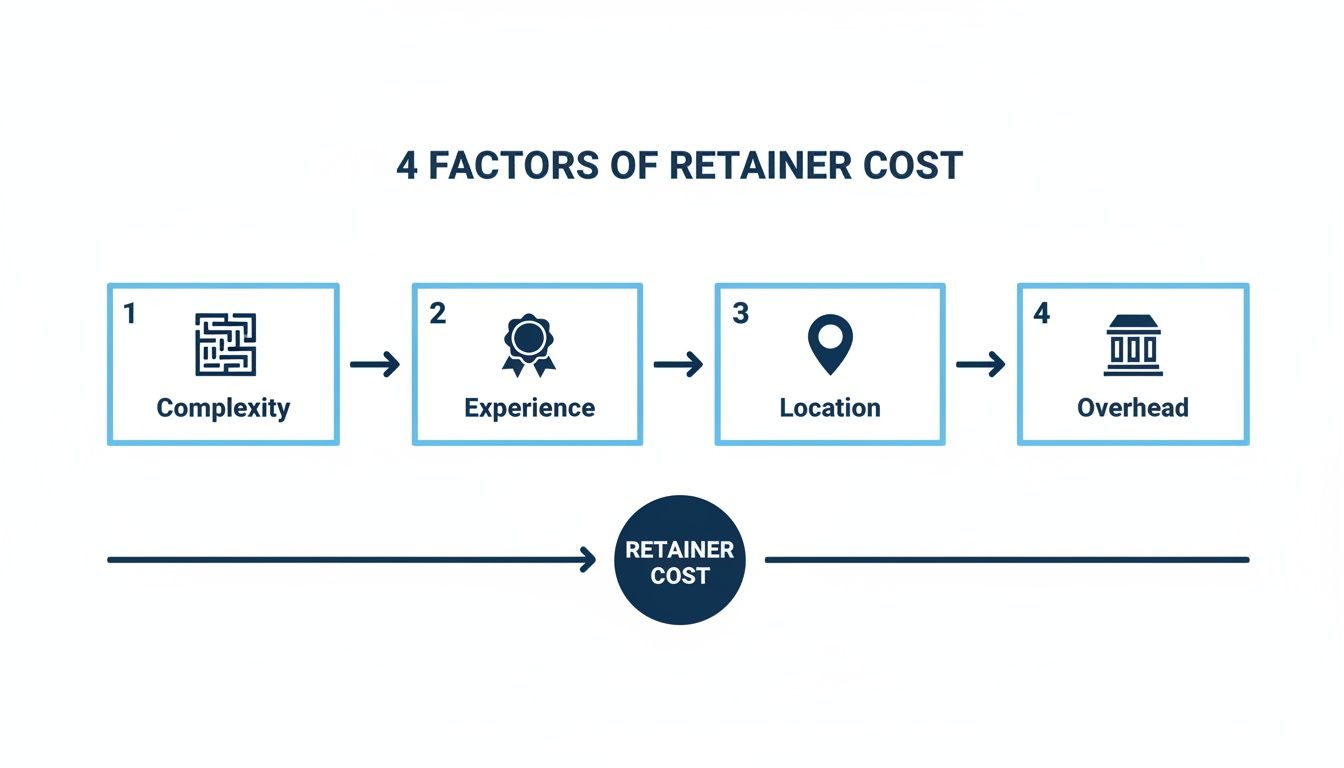
Why does one lawyer quote a $2,500 retainer while another in the same city asks for $10,000? It’s not arbitrary. Justifying your fee is about explaining the logical pillars that support your pricing.
Your Experience and Expertise
Your years in practice are a tangible asset. You’re not just selling time; you’re selling foresight and a track record that can change a case's outcome.
Frame it this way: "Because I've handled dozens of cases like yours, I know the common pitfalls we need to avoid from day one." This positions your higher fee as insurance against rookie mistakes.
The Complexity of the Case
No two cases are the same. A simple, uncontested divorce is different from one involving hidden assets and a custody battle. The more variables, the more time and resources the case will demand.
Rising operational costs have pushed average attorney retainers higher, especially for complex matters. For example, retainers for serious felonies can now range from $5,000 to $15,000 or more. You can learn more by reviewing this attorney fee guide.
Geographic Location and Overhead
Your firm's location matters. An office in downtown Manhattan has a different overhead than a practice in a small town. These real-world costs—rent, salaries, technology—are baked into your rates.
This factor ties directly to your firm's operational model and the investments you've made to serve clients. When a client understands these market realities, your retainer feels grounded in business logic.
How to Collect Lawyer Retainer Fees Instantly
The old way of collecting retainers is a conversion killer. You email a PDF, hope the client has a printer, wait for them to sign and scan, then hope they mail a check. Every step is a point of friction where a motivated client can lose momentum.
Imagine sending one secure link where your new client can review the agreement, sign it on their phone, and pay the retainer by credit card—all in under five minutes. This modern, unified workflow eliminates phone tag and manual follow-up.
From Days to Minutes: The Power of a Unified Workflow
The secret is consolidating the three most critical intake steps—the intake form, the e-signature, and the payment—into one seamless experience.
This approach removes the administrative burden that bogs down your firm. Attorneys spend 48% of their time on non-billable admin tasks, a massive drain on profitability. Automating retainer collection reclaims that time so your team can focus on billable legal work.
Your One-Link Retainer Process
A modern intake platform transforms your process into an efficient, on-brand experience. This simple flow gets clients signed and paid in minutes, drastically reducing drop-off. For more on this, you might find insights from payment collection experts who specialize in making this process smoother.
By combining these steps, you make it incredibly simple for a client to hire you. You can also explore our guide on crafting a compelling lawyer retainer letter to make this process even more effective.
Essential Clauses for Your Lawyer Retainer Agreement
A vague retainer agreement is a disaster waiting to happen. It's the biggest source of client disputes and unpaid bills. This document is the rulebook for your relationship.
Think of your retainer agreement as the blueprint for the engagement. It has to be airtight.
Defining the Scope of Work
This is the most critical clause. Be crystal clear about what services are covered by the retainer—and just as important, what is not included.
For example, your agreement might state the retainer covers representation through trial but explicitly excludes any appellate work. This simple clarification stops scope creep and gives you a contractual basis to bill for additional work later.
Payment Terms and Replenishment Rules
Your agreement must spell out every financial detail: your hourly rate, invoice frequency, and exactly how you bill against retainer funds. While law firms have demonstrated pricing power, this has come alongside rising operational costs, as noted in the latest Law Firm Rates Report.
For evergreen retainers, specify the minimum balance and the top-up procedure. For instance: when the trust balance drops below $1,500, the client must replenish it to the original $5,000 within 10 business days. This language prevents cash flow gaps. Find more practical examples in our legal retainer agreement template.
FAQs About Retainer Cost for a Lawyer
Even with a solid agreement, clients have questions. Getting these answers right manages expectations and helps you handle client funds ethically.
What happens if the retainer is more than the final bill?
You give the money back. The initial retainer sits in your client trust account (IOLTA) until you’ve done the work. Once the case is over, you send a final invoice. Whatever is left in the trust account gets refunded to the client, promptly and without exception.
Can I charge a non-refundable retainer?
This is tricky and depends entirely on your state bar's rules. Some jurisdictions allow a "true retainer"—a non-refundable fee paid to secure your availability and take you off the market. This is a fee for access, not for future work.
However, most retainers are advance payments for future services, and that money must be refundable until earned. If you’re considering a non-refundable portion, spell it out explicitly and triple-check your local ethics rules.
How should I handle a client who disputes a charge?
Address it immediately. Schedule a quick call and walk through the invoice line-by-line, connecting the work back to the scope you agreed on. More often than not, a clear explanation resolves the misunderstanding. If you made a mistake, own it, fix it, and send a corrected invoice. A transparent approach builds credibility.
Ready to eliminate the administrative headaches of collecting retainers? intake.link combines e-signatures, payments, and forms into one link, so you can get hired and paid in minutes, not days. Stop losing leads—get signatures before they call another firm.