

Losing a great lead because your retainer process is slow and clunky is a painful, avoidable cost. This guide breaks down exactly how a retainer for a lawyer works so you can get clients signed and paid in minutes, not days. Think of it as an upfront payment to reserve your services—a deposit held securely in a trust account until you earn it.
By streamlining this process, you build immediate trust and make it easy for clients to say yes before they call another firm.
Stop Chasing Payments and Get Retained Faster
You’ve aced the consultation and the client is ready to hire you. But then the friction starts. You ask them to print a document, sign it, scan it, and then figure out how to make a separate payment.
This delay is dangerous. Every hour of hesitation gives a warm lead time to second-guess their decision or, worse, call another firm that makes it easier. Research shows that leads contacted within 5 minutes are 21x more likely to convert, and that momentum dies the second you introduce paperwork friction. You need to turn that "yes" into a signed agreement and a paid invoice instantly. For a complete strategy on locking in clients, our cornerstone guide on how to stop losing leads with faster conversions is a must-read.

Why a Slow Retainer Process Kills Conversions
The old way of collecting retainers is riddled with administrative bottlenecks that create a terrible first impression. It silently tells the client that working with your firm is going to be slow and complicated.
Here’s where your process is likely breaking down:
- Manual Paperwork: Sending PDFs for clients to print and sign is an outdated hassle that screams inefficiency.
- Separate Payment Steps: Making them navigate to another system or, even worse, asking for a check, adds another layer of friction they don't have time for.
- Delayed Follow-Up: Chasing down signatures and payments is non-billable time you can never get back.
This disjointed experience doesn't just waste your time; it actively costs you clients. For more details on what to include in your agreement, check out our guide on creating a legal retainer agreement template to protect your firm. By combining the signature and payment into a single, seamless step, you eliminate the opportunity for client drop-off.
Decoding the Different Types of Lawyer Retainers
Not all retainers are created equal. Choosing the right structure is critical for managing client expectations and your firm’s cash flow. Explaining these options clearly builds immediate trust and can head off payment disputes down the road.
When clients understand the "why" behind your fee structure, they feel much more confident moving forward. Let's break down the most common models.
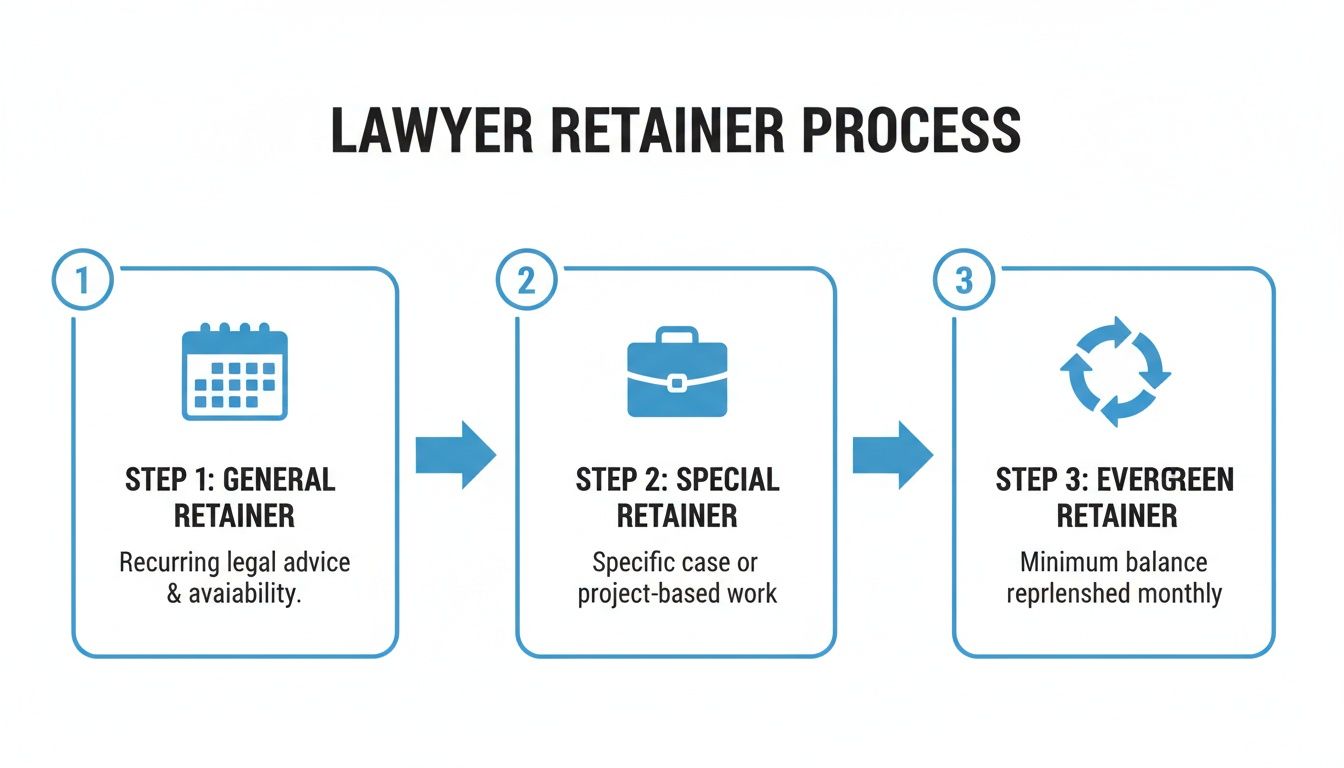
The General Retainer: Securing Your Availability
A general retainer is the simplest of the bunch. It’s a fee a client pays just to keep you on standby for a specific period. This isn't a down payment for future work; it's a fee for ensuring you'll be available—and won't represent their competitors.
This model is a perfect fit for business clients who need ongoing counsel but don’t have a specific, large project. Because it’s earned the moment you receive it, the fee goes directly into your firm's operating account.
The Special Retainer: Funding a Specific Task
The special retainer is what most people picture: an advance payment for a specific case, like a divorce proceeding or a contract negotiation.
Unlike a general retainer, these funds are unearned until you perform the work. You must deposit the full amount into a client trust account. Only after you’ve invoiced the client can you transfer the earned portion to your operating account. Understanding the nuances of this type of lawyer retainer fee is absolutely essential for compliance.
The Evergreen Retainer: The Self-Replenishing Fund
The evergreen retainer is a popular version of the special retainer, especially for hourly billing. It prevents that awkward moment when you have to stop work because a client’s initial deposit has run out.
The client pays an initial retainer into the trust account. Your fee agreement states that when the balance drops below a certain threshold (say, $1,500), the client must replenish it back to the original amount. This structure ensures you always have funds to work from, eliminating the need to chase down payments mid-case.
Comparing Legal Retainer Models
Here’s a quick-glance comparison of these common retainer types.
| Retainer Type | Primary Use Case | How It Works |
|---|---|---|
| General Retainer | Ongoing availability for a client who needs regular counsel. | A flat fee paid to secure your availability. Earned on receipt and deposited into the firm's operating account. |
| Special Retainer | Funding a specific legal project like a lawsuit or divorce. | An advance payment held in a client trust account. Funds are transferred to the operating account only after work is performed and invoiced. |
| Evergreen Retainer | Long-term hourly matters where total costs are unpredictable. | A type of special retainer where the client must replenish the trust account balance whenever it falls below an agreed-upon minimum. |
Matching the retainer structure to the legal work ensures clarity and financial stability for everyone involved.
Mastering Trust Accounts vs. Operating Accounts
Mishandling client funds is one of the fastest ways to get into serious trouble with the bar. You absolutely have to get this right: the money your client pays you upfront isn't your money yet.
Think of it this way: your client’s retainer fee is like a prepaid card they hand you. You can only use it after you’ve done the work and given them a detailed invoice. Until then, the money must sit, untouched, in a separate bank account.
The Lifecycle of a Retainer Fee
The entire process follows a simple, three-step flow designed to keep you compliant with state bar regulations.
- Deposit into Trust: The moment a client pays their retainer, that full amount goes directly into your client trust account (often an IOLTA account). Legally, this money is still the client's property.
- Perform and Invoice: As you work, you track your billable hours and expenses. At the end of your billing cycle, you create a detailed invoice showing exactly what you did and how much you have now earned.
- Transfer to Operating: Only after you’ve sent that invoice to the client can you transfer the exact earned amount from the trust account to your firm's operating account.
This strict separation is mandatory. Commingling funds—like dropping a retainer check directly into your operating account—is a major ethical breach.
Maintaining Meticulous Records
Keeping precise, separate records for these accounts is critical. You have to be able to account for every single dollar. Learning how to manage financial documents efficiently, like properly processing PDF bank statements, can make a huge difference in keeping your reconciliations clean.
In 2023, the average lawyer retainer fee ranged from $1,973 for an immigration case to $4,015 for a bankruptcy matter. With sums that large changing hands constantly, flawless accounting isn't just a good habit—it's essential for your firm's survival.
Drafting a Retainer Agreement That Prevents Disputes
Your retainer agreement is the foundation of the attorney-client relationship. A vague agreement is a surefire recipe for fee disputes, but a clear contract is your best tool for setting boundaries and managing expectations from day one.
This is your chance to define exactly how a retainer for a lawyer works for your client's specific case. When questions about a charge or the scope of your work pop up, this signed agreement becomes the single source of truth.
Essential Clauses for Every Agreement
While every agreement needs tailoring, some clauses are non-negotiable. Make sure your agreement always includes:
- Scope of Representation: Get hyper-specific about what services you’re providing and, just as crucial, what you are not providing.
- Fee Structure: Clearly list the hourly rates for everyone who might work on the file. If you're using a flat fee, define exactly what that price covers.
- Replenishment Policy: For any evergreen retainer, spell out the minimum balance that triggers a request for more funds (e.g., $1,500) and the exact replenishment amount.
- Conditions for Termination: Outline how either party can end the relationship and explain what happens to the client’s money and file upon termination.
For a deeper dive, our guide on what is a retainer agreement offers more context and examples to help you craft a bulletproof document.
Avoiding Common Agreement Pitfalls
Even well-intentioned agreements can backfire. One of the biggest offenders is using fuzzy language like "reasonable efforts" or "general legal advice." These terms lead to clients expecting far more than you planned to deliver.
Your agreement should read like a clear instruction manual, not a legal treatise. Another landmine is failing to detail how out-of-pocket costs like filing fees and expert witness costs will be handled. Specify whether these will be deducted from the retainer or billed separately to avoid surprise invoices.
How to Automate Your Retainer Collection Process
The gap between a client saying "yes" and your firm getting paid is where you lose business. Every hour spent playing phone tag, waiting for a scanned document, or juggling separate links for signing and paying creates friction.
The fix is to stop thinking in separate steps and start thinking in a single action. Modern tools let you combine your entire intake workflow into one simple link. You send one text or email where a new client can fill out their info, e-sign the agreement, and pay their retainer—all in one seamless session.
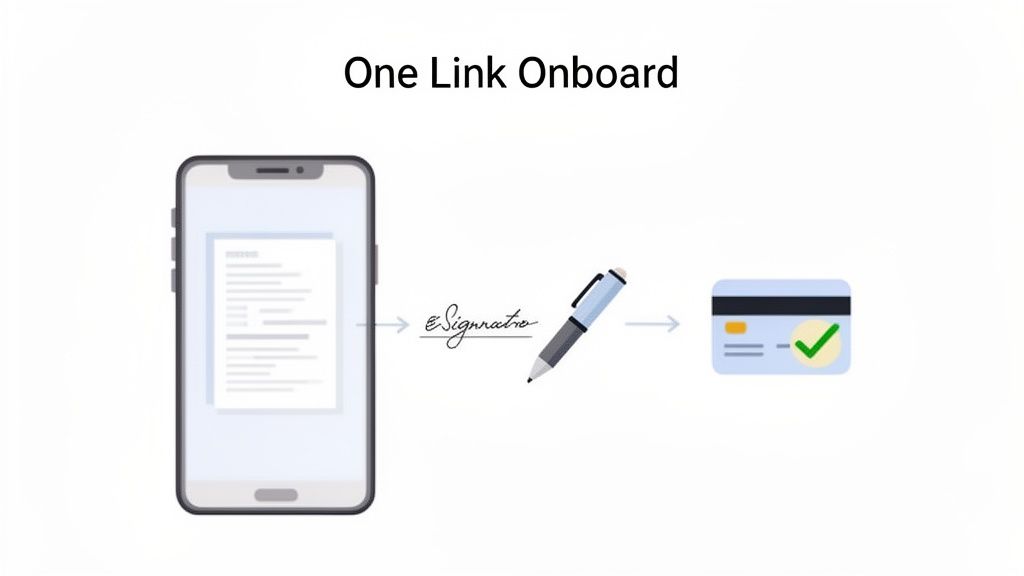
This simple shift transforms your onboarding from a multi-day administrative headache into a five-minute task.
From Friction to Five-Minute Onboarding
The old way of doing things is a conversion killer. You email the agreement, wait for the signature, and then send a separate payment link. At each step, you risk the client getting distracted or losing momentum.
A unified intake flow closes those drop-off points for good. Think about the difference:
- Old Way: Three separate actions (form, signature, payment) spread over days of follow-up.
- New Way: One link, one session, one retained client in under five minutes.
This isn't just about convenience; it's a massive competitive advantage that leverages a client's commitment at its peak.
The Mechanics of a Unified Workflow
This process is simpler than it sounds. Platforms consolidate tools you already use—like e-signatures and Stripe for payments—into a single, branded experience for your client. For a small firm, understanding how a retainer for a lawyer works on an operational level is the key to scaling without hiring more staff.
While 78% of firms accepted online payments in 2023, many still get bogged down by using disjointed systems. Unified flows solve this by letting your team guide leads via SMS or email to sign and pay on the spot. To learn more, check out these insights on corporate legal department benchmarks and explore the best accounts receivable software to streamline your entire collections process.
Your Next Steps to a More Profitable Practice
Knowing how a retainer for a lawyer works is one thing; collecting them without chasing clients is another. The goal is to demolish every administrative bottleneck that bleeds time and money from your practice.
Stop thinking of client onboarding as a checklist: send form, chase signature, remind about payment. This fragmented approach is precisely where your best leads fall through the cracks.
Define and Automate Your Process
A profitable practice is built on clarity and automation. Your next step should be to audit your entire client intake experience. Ask a few hard questions:
- Is my retainer model crystal clear?
- Is my agreement airtight and easy to understand?
- Is my collection process frictionless? How many clicks, emails, and phone calls does it take for a client to go from "yes" to retained?
If the answer to that last question is more than one, you have a problem. The firm that makes it easiest to hire them wins. Automating your intake is the single biggest lever you can pull to get your time back.
Consolidate Your Tools for Faster Conversions
The answer isn't piling on more software; it's using fewer, better-integrated tools. A system that combines e-signatures, payment processing, and intake forms into one seamless flow is no longer a luxury—it’s a competitive necessity.
When you adopt a unified workflow, you stop losing clients to friction and delays. You start converting them in minutes, capturing their commitment at its peak. This is how you build a practice that runs on systems, not just your personal effort.
Frequently Asked Questions About Lawyer Retainers
Answering common questions upfront builds trust and cuts down on back-and-forth emails. Here are the plain-English answers to the questions your clients will ask.
Is a Retainer Fee Refundable if I Do Not Use All the Funds?
Yes, in most cases. Think of a special or evergreen retainer like a prepaid card for legal services. The money is legally yours until your lawyer does the work to earn it. Any unearned portion is held in a trust account and must be refunded to you promptly if the case concludes with a balance remaining.
What Is the Difference Between a Retainer and a Flat Fee?
A retainer is an advance deposit for ongoing work that will be billed by the hour. You're pre-paying for your lawyer's future time. A flat fee is a single, all-in price for a specific, well-defined project, like drafting a simple will. You pay one price for one result, regardless of how many hours it takes.
What Happens if My Retainer Runs Out but My Case Is Not Over?
This is a normal part of any case billed by the hour. Your retainer agreement will have an evergreen retainer clause. For example, if you paid a $5,000 retainer, the agreement might state that you need to bring the balance back up to that amount whenever it drops below $1,500. This ensures your legal team can continue working without interruption.
Stop losing leads—get signatures before they call another firm.