

Every hour that passes after a great consultation is an invitation for your potential client to call another firm. Your modern retainer letter lawyer playbook is simple: get a signature and payment in one step, before the lead goes cold. If you're still emailing PDFs and waiting for checks, you're losing clients to firms that have already closed the deal.
The High Cost of a Slow Retainer Process
You’ve felt it. A great initial consultation fades into radio silence. This is a direct symptom of a slow, clunky retainer process where every manual step—emailing a PDF, asking the client to print it, waiting for a check—creates friction and doubt.
That friction gives a motivated client time to second-guess their decision or find a competitor who makes it ridiculously easy to get started. Data shows that leads contacted within 5 minutes are 21x more likely to convert, which means every hour you wait to finalize the engagement is a massive risk. We have a full guide on how to stop losing leads—get signatures before they call another firm.
This delay doesn’t just lose one client; it costs you their lifetime value and future referrals. Meanwhile, the administrative drag eats into your firm's productivity, pulling you away from billable work to chase paperwork and follow up on payments.

Why Client Expectations Demand a Faster Lawyer Retainer Process
Today's clients expect instant, digital experiences. Legal services are no exception. A slow, clunky onboarding process is a major liability that suggests your firm is inefficient or outdated—the last impression you want to make.
The solution is to consolidate the entire process—agreement, payment, and initial intake—into a single, seamless action. Imagine a potential client reviewing your terms, signing electronically, and paying their retainer deposit all in one flow, right from their phone.
This closes the gap between their decision to hire you and the moment they actually become a paying client. This unified approach transforms your intake from a deal-breaker into your biggest competitive advantage, securing clients before they look elsewhere.
Drafting an Ironclad Retainer Letter Template
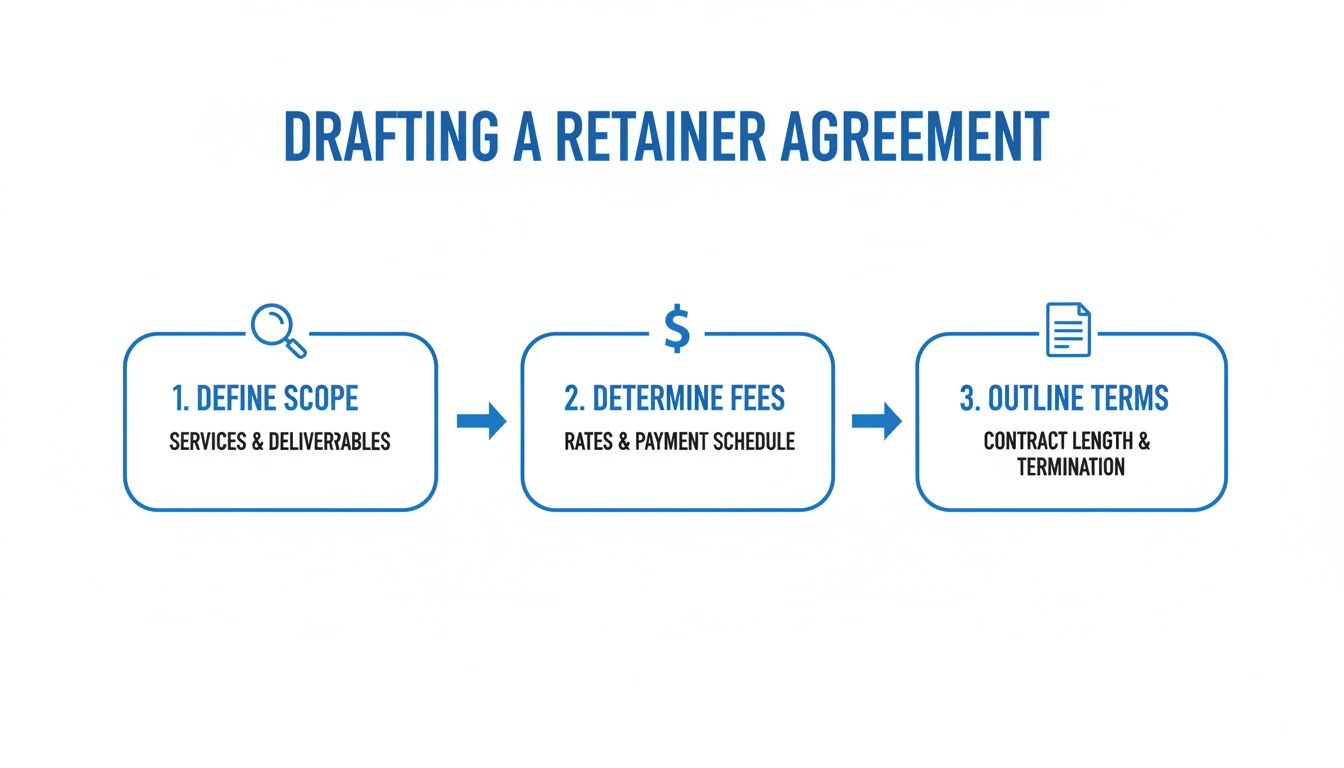
Your retainer letter is the foundation of the client relationship, and a solid template is a critical asset. Done right, it prevents scope creep, fee disputes, and ethical headaches. Done wrong, it’s a recipe for disaster.
The goal is to create a clear, reusable document that protects your firm and manages client expectations from day one. A template saves you from reinventing the wheel and minimizes the risk of leaving out a critical clause. To build one that works, you need to understand how to draft a contract with precision.
Clarity is key. The best retainer letter is one the client can actually understand, which builds trust and sets a professional tone for the entire engagement.
Key Clauses Your Retainer Letter Must Include
Ambiguity is your enemy. Think of the retainer letter as the official rulebook for the engagement, leaving no room for misinterpretation. Use plain language to define the boundaries and responsibilities for both you and your client.
These are the non-negotiable clauses every template must contain.
The Big Three: Scope, Fees, and Responsibilities
Precise Scope of Representation: Define exactly what you will do and, just as importantly, what you will not do. Instead of "handle the divorce," get specific: "Representation through mediation and filing of the final divorce decree, excluding any post-judgment modifications or appeals." This is your best defense against scope creep.
Unambiguous Fee Structure: Whether it's hourly, flat, or contingency, spell it out. For hourly rates, state who bills at what rate (Partner at $450/hr, Associate at $300/hr) and in what increments (0.1 of an hour). Detail costs versus fees, explaining that filing fees or expert witness costs are separate.
Client Responsibilities: The client has a job to do. Outline their obligations, like providing documents in a timely manner, being truthful, and showing up for meetings or hearings. This reinforces that the attorney-client relationship is a two-way street.
A retainer letter isn’t just a formality—it's your primary risk management tool. A single sentence clarifying scope can save you from dozens of hours of unbillable work and a potential malpractice claim.
Essential Clauses for a Lawyer's Retainer Letter
This table breaks down the must-have components of any robust retainer letter. Having these locked down in your template means you're not starting from scratch; you're starting from a position of strength.
| Clause | Purpose | Key Information to Include |
|---|---|---|
| Identification of Parties | Clearly establishes who the agreement is between. | Full legal names and contact information for the client and the law firm. |
| Scope of Representation | Prevents scope creep and manages expectations. | Specific services to be provided and, crucially, services that are excluded. |
| Fee Structure | Avoids fee disputes and ensures transparency. | Detailed breakdown of hourly rates, flat fees, or contingency arrangements; deposit amount. |
| Costs and Expenses | Differentiates fees from out-of-pocket costs. | Explanation of what constitutes a cost (filing fees, experts) and how they will be billed. |
| Billing and Payment Terms | Sets clear payment expectations. | Frequency of invoices (e.g., monthly), payment due dates, and consequences for non-payment. |
| Client Responsibilities | Outlines the client's role in the engagement. | Obligation to be truthful, provide documents promptly, and cooperate with the firm. |
| Termination/Withdrawal | Provides a clear exit strategy for both parties. | Conditions under which either party can end the relationship; protocol for file return. |
| Conflicts of Interest | Fulfills ethical duties and informs the client. | Disclosure of any potential conflicts and confirmation of the client's consent to proceed. |
| Communication Policy | Manages client communication expectations. | How and when the client can expect updates; preferred communication methods. |
| File Retention Policy | Informs the client about your firm's document policy. | How long the firm will retain the client's physical and digital files after the matter closes. |
Protecting Your Firm with Clear Exit Clauses
Just as important as defining how the relationship starts is outlining how it can end. Your retainer must give you a clear, ethical path to withdraw if the relationship breaks down.
Include specific language for both termination (ending the agreement) and withdrawal (getting off the record). Detail the circumstances, such as non-payment or failure to follow legal advice, and explain the protocol for file return and the final bill. This ensures an orderly conclusion.
Get Your Retainer Agreement Signed in Minutes, Not Days
How much revenue are you losing to a slow retainer process? The old way—printing, mailing, waiting—is a client-killer. In the time it takes for a document to travel through the mail, a motivated prospect has already hired one of your competitors.
A modern law firm gets its retainer agreements signed in minutes. This isn't about being tech-savvy; it's about closing the deal while the client is still on the phone and ready to commit. Every manual step you force on a client is an opportunity for them to drop off.
Picking the Right E-Signature Tool
The right tool does more than capture a signature. Look for a solution that lets you send the retainer for signature through both SMS and email, so you can get it signed while you're still talking to the client on their consultation call.
Crucially, your tool must comply with the federal E-SIGN Act. It needs to generate a clean audit trail showing who signed, when they signed, and from where. Make sure you understand the specific electronic signature legal requirements so your digital agreements are as solid as wet ink.
Strike While the Iron Is Hot
With 58% of consumers now preferring virtual meetings for initial consultations, a fully digital onboarding process is no longer optional. The trick is to send the agreement the second a client says "yes."
Send the signature link while you are still on the phone. This simple action collapses the timeline from days to seconds, capitalizing on the client's peak interest and commitment.
A modern workflow also gives you real-time tracking to see when a client opens, views, and signs the document, removing the guesswork from follow-up. This speed is a core conversion strategy that directly impacts your bottom line.
Collect Retainer Fees Instantly at Signing
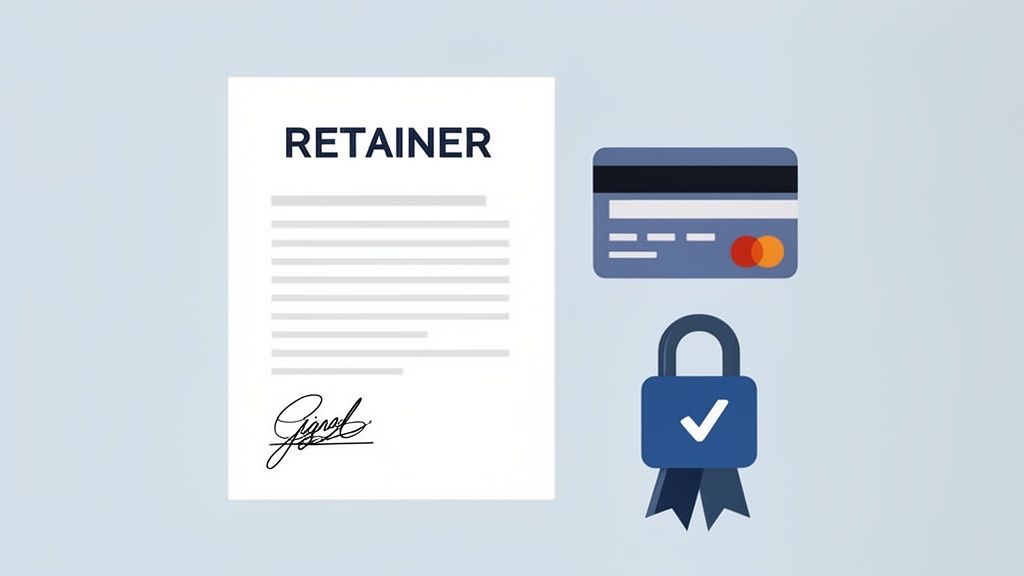
A signature is a win, but it's only half the battle. If you're still waiting for a check to arrive and clear, the engagement hasn't officially started, and your cash flow is taking a hit. The most effective firms collect the retainer fee the moment the client signs.
This isn’t just about getting paid faster; it’s about cementing commitment. A paid retainer transforms a prospect into a client who is emotionally and financially invested. By building the payment step directly into your signing workflow, you eliminate awkward follow-up calls chasing a deposit.
Unifying the Final Step for Your Client Retainer
Modern intake systems automatically pop up a payment screen the second after the client e-signs your retainer letter. They sign the document, and the next screen prompts them to securely pay their deposit with a credit card or ACH transfer. It’s one seamless workflow.
For clients, it’s a simple, professional experience. For you, it means funds land directly in your trust or operating account without your team lifting a finger. Of course, you need to understand if and how lawyers should accept credit card payments to stay compliant.
By combining the signature and payment, you close the deal completely. There’s no gap for hesitation or buyer's remorse, and you can start substantive work immediately with the security of a paid retainer.
Setting Up Your Integrated Payment Workflow
To make this happen, connect your e-signature tool with a payment processor like Stripe. The setup should be straightforward and give you total control over where the money goes.
Look for these key features:
- Automatic Invoicing: Instantly generate an invoice for the retainer amount without manual work.
- Trust vs. Operating Account Routing: You must be able to direct funds to either your IOLTA/trust account or your operating account to maintain compliance.
- Secure Payment Processing: Ensure the platform uses a reputable, PCI-compliant payment gateway to protect client financial data.
This isn't a complicated technical overhaul. It’s a simple shift that accelerates cash flow, cuts administrative work, and creates a powerful first impression that secures client commitment on the spot.
Automating Your Post-Retainer Workflow
Getting the retainer signed and paid is a huge milestone. But what happens next is what separates efficient firms from those bogged down in admin work.
If your process involves manually typing client details from an intake form into your practice management software, you’re wasting time and creating opportunities for mistakes. A signed retainer should trigger your firm’s operational machine, not another manual to-do list.
This is where you build a massive advantage by connecting your intake to your backend systems. You can learn more in our guide to scaling law firm operations systems that scale.
Creating a Hands-Off Client Onboarding Flow
Picture this: the second a client submits their signed retainer and payment, a chain reaction happens automatically. No one on your team has to lift a finger.
This hands-off workflow can trigger a sequence of critical actions:
- Create a New Matter: A case file is instantly opened in your practice management software, like Clio or PracticePanther.
- Sync All Client Data: Every detail from intake—names, contact info, case specifics—is perfectly mapped to the correct fields. No typos.
- Send a Welcome Email: A pre-written welcome email goes out, confirming receipt and setting expectations for what’s next.
- Notify Your Team: An alert hits your inbox or a Slack channel, letting everyone know a new client is officially on board.
This is what competitive small firms are doing right now. By connecting your intake tool with your other software, you start clawing back the 48% of time attorneys spend on non-billable admin tasks.
Why Automation is a Lawyer's Secret Weapon
Manual data entry isn't just slow; it's a liability. One wrong digit in a case number can create headaches that take hours to fix. Automation eliminates that risk, ensuring your data is pristine from day one.
This is how a two-person firm does the work of four. It’s not about grinding harder; it’s about building smart systems that handle the grunt work for you. That frees you up to focus on legal strategy and billable hours.
With 60-67% of law firms now using retainers to stabilize cash flow, the firms that process them most efficiently have a clear edge. You can explore advanced solutions like AI powered sales automation to manage follow-ups, but the foundation is a solid, automated workflow.
Common Questions About Lawyer Retainer Letters
Getting the details right on your retainer letter reinforces the trust you're building with a new client. Here are direct answers to common questions from small firms.
What Is the Difference Between a Retainer Letter and an Engagement Letter?
The terms are often used interchangeably, but there's a key distinction. A retainer letter or agreement specifically implies you are collecting a retainer fee—an advance payment. It formalizes that financial commitment.
An engagement letter simply outlines the scope of services and terms of the relationship. It might not involve an upfront retainer. If you're taking a deposit, calling the document a "Retainer Agreement" is the most accurate choice.
Are E-Signatures Legally Binding for Retainer Agreements?
Yes, absolutely. E-signatures are legally valid and binding in the U.S. under the federal Electronic Signatures in Global and National Commerce Act (E-SIGN Act) and corresponding state laws.
The key is using a platform that provides a clear audit trail. This log should document the signer's intent, capturing their IP address and the exact timestamp of the signature. With that evidence, your e-signed retainer is as enforceable as one signed with a pen.
How Can I Ensure My Client Understands the Retainer Letter?
Clarity is your best tool. Your goal is for the client to feel informed, not intimidated.
- Use Plain English: Ditch the dense legalese. Write for a smart, non-lawyer audience.
- Structure for Skimmability: Use clear headings, short paragraphs, and bullet points to break up dense sections like fees and scope.
- Discuss Key Terms: Before sending the document, take five minutes on the phone to walk them through the most important clauses.
A transparent process from the start minimizes future misunderstandings. A client who understands the agreement is a client who trusts you.
What Is the Best Way to Handle a Replenishing Retainer?
Chasing retainer replenishments is a major administrative headache. Your retainer letter should clearly state the minimum balance to be maintained and the process for replenishment.
The best practice is to use a payment system that can securely store a client's payment method on file (with their authorization). When the balance drops below the threshold, the system can automatically charge the card to bring it back to the agreed-upon level, ensuring you never have to pause work for an awkward money conversation.
Stop losing leads in the gap between consultation and signature. intake.link combines your retainer agreement, payment collection, and intake forms into a single link you can send on the spot.
Stop losing leads—get signatures before they call another firm